Electronics enclosure
An enclosure holds a circuit board on four screw bosses and closes with a lid that sits in a rebate around its rim. Its wall has the same thickness all around, so the inside is the outline offset inward by the wall. That one offset of the sketch, pocketed down to the floor, keeps the wall’s thickness and rounds the inside corners by itself. The rebate is a ring, the inside offset outward less the inside, pocketed from the top. Model the enclosure from the drawing in planex2d or in any CAD system, then check its volume, mass and center of mass against the values at the end of the page. A solution in planex2d follows.

[1]:
import math
import netgen.occ as occ
import planex as px
The outline
The enclosure is 100 by 60 outside and 35 high, its corners rounded with a radius of 8. The outline is a RectangleC around the origin on the xy plane, its four corners filleted, and each fillet makes its radius a dimension, corner_1.r to corner_4.r. px.Pad extrudes it 35 up (Figure 1):
[3]:
outline = px.Sketch(auto_constraint=True)
outline.RectangleC(100, 60, id="box")
outline.Constrain("box.center", "origin", px.Coincident)
outline.Constrain("box.Line.1", px.Horizontal)
outline.Constrain("box.Line.1", px.Distance, 100, id="length")
outline.Constrain("box.Line.2", px.Distance, 60, id="width")
outline.Fillet(["box.Line.1.start", "box.Line.2.start", "box.Line.3.start", "box.Line.4.start"], 8,
               id=["corner_1", "corner_2", "corner_3", "corner_4"])
print("status", outline.status, "| degrees of freedom", outline.dof)
box = px.Pad(outline, 35)
status full | degrees of freedom 0
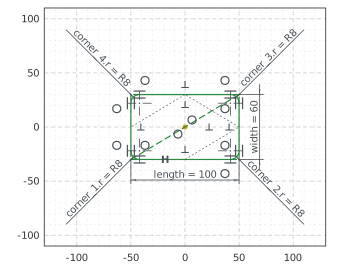
(a) The outline, every dimension and tie
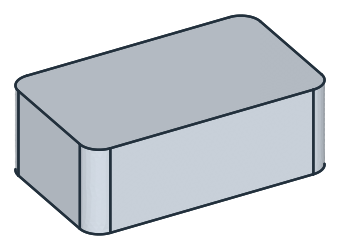
(b) Padded 35
The inside
The wall is 2.5 thick all around, and so is the floor. The inside is the outline’s face offset by -2.5, inward, a rectangle of 95 by 55 whose corners have the radius \(8 - 2.5\), around the same centers. It is pocketed from the top, \(35 - 2.5\) deep, down to the floor (Figure 2):
[5]:
inside = outline.Face().Offset(-2.5, inplace=False)
inside_top = inside.Translated((0, 0, 35))
box = px.Pocket(box, inside_top, 35 - 2.5)
print("inside", round(inside.mass, 4), "mm², exact", round(95 * 55 - (4 - math.pi) * 5.5**2, 4))
inside 5199.0332 mm², exact 5199.0332
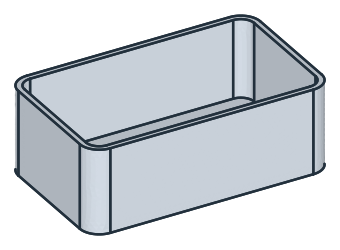
The bosses
The four screw bosses stand on the floor, around the centers of the corners’ arcs, 42 and 22 from the middle. They are rings of 8 outside with holes of 2.5 for self-tapping screws, 1.5 clear of the inside corners. Two circles nested in one sketch are a ring. They are sketched on the floor, the xy plane lifted by 2.5, and padded 27.5 up, so that they end 5 below the rim (Figure 3):
[7]:
bosses = px.QuickSketch(px.Plane(px.XY, 2.5))
for x in (-42, 42):
    for y in (-22, 22):
        bosses.Circle(8 / 2, center=(x, y)).Circle(2.5 / 2, center=(x, y))  # a ring: the hole nested in the boss
box = box + px.Pad(bosses, 27.5)  # + fuses the bosses with the box
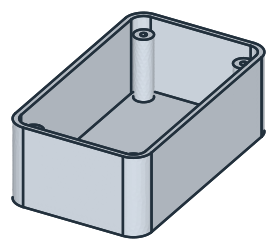
The rebate
The lid sits in a rebate around the rim, 1.2 wide and 2 deep. The rebate’s face is a ring between the inside and the inside offset outward by 1.2, their difference -, and it is pocketed 2 deep from the top (Figure 4):
[9]:
rebate = inside.Offset(1.2, inplace=False) - inside
box = px.Pocket(box, rebate.Translated((0, 0, 35)), 2)
print("rebate", round(rebate.mass, 4), "mm²")
rebate 353.1929 mm²
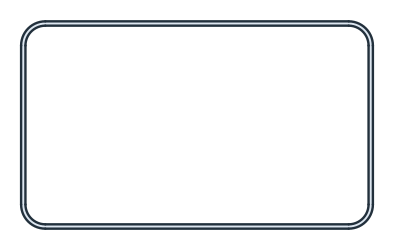
(a) The rebate's ring
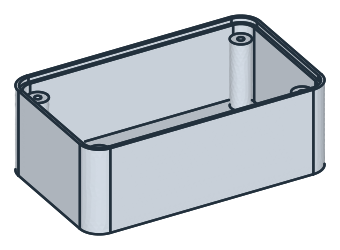
(b) The rebate around the rim
The checks
These are the volume, the mass in aluminum EN AW-6082 (2.70 g/cm³) and the center of mass, with the origin in the middle of the bottom, to compare with your own model. Every part has an exact area. A rectangle \(a\) by \(b\) whose corners are rounded with a radius \(r\) has the area \(a b - (4 - \pi) r^2\), and the volume is the outline times 35, less the inside times 32.5, plus the four bosses’ rings times 27.5, less the rebate’s ring times 2. The enclosure is symmetric about two planes, so its center of mass lies on the vertical axis:
[11]:
def rounded(a, b, r):
    return a * b - (4 - math.pi) * r**2


ring = rounded(97.4, 57.4, 6.7) - rounded(95, 55, 5.5)  # the rebate
exact = (rounded(100, 60, 8) * 35 - rounded(95, 55, 5.5) * 32.5 + 4 * math.pi * (4**2 - 1.25**2) * 27.5 - ring * 2)
c = box.center
print("volume", round(box.mass, 2), "mm³, exact", round(exact, 2))
print("mass", round(box.mass * 2.70e-6, 4), "kg")
print("center of mass", round(c.z, 3), "above the bottom, off the axis by", round(math.hypot(c.x, c.y), 6))
volume 43391.45 mm³, exact 43391.45
mass 0.1172 kg
center of mass 12.22 above the bottom, off the axis by 0.0
The enclosure as STEP, for another CAD system:
[12]:
box.WriteStep("enclosure.step")
The enclosure as STEP: enclosure.step