Formulas: a dipstick for a tank
A horizontal cylindrical tank holds 10 % of its volume below a height that no formula gives: the area of a circular segment of height h is
A(h) = r² acos((r − h)/r) − (r − h) √(2rh − h²),
and it cannot be solved for h, which is why tank makers print tables. In a planex2d sketch, the formula itself is the rule. A mark is a horizontal chord with both ends on the tank’s shell, and one Expression states that the segment below it holds its share of the circle. The solver finds every mark at once, and the dimensions of the tank remain free to change.
[1]:
import math
import planex as px
One rule per mark
The tank has a diameter of 2 m and is 5 m long. Its section is sketched in millimeters with the bottom of the shell at the sketch’s origin and the center on the vertical axis, so the height of a mark above the bottom is simply the v coordinate of its start, mark1.start.v. The marks are drawn evenly spaced, by eye, and each gets the formula as its rule: segment area = k/10 of π r². Expressions take angles in degrees, so acos is turned into radians with pi/180.
[3]:
r, length = 1000, 5000
segment = "r^2*acos((r - {h})/r)*pi/180 - (r - {h})*sqrt(2*r*{h} - {h}^2)"

tank = px.Sketch(id="tank")
tank.Circle(0, r, r, id="shell")
tank.Constrain(tank.origin, "shell", px.Coincident)
tank.Constrain("shell.center", px.V, px.Coincident)
tank.Constrain("shell", px.Radius, r, id="r")
for k in range(1, 10):
    tank.Move((-r, k * r / 5)).Line(2 * r, 0, px.Horizontal, id=f"mark{k}")
    tank.Constrain(f"mark{k}.start", "shell", px.Coincident)
    tank.Constrain(f"mark{k}.end", "shell", px.Coincident)
    tank.Expression(segment.format(h=f"mark{k}.start.v") + f" = {k / 10}*pi*r^2")
print(tank.status, tank.dof)
full 0
Marks at equal steps of height would be far off, because the bands between them hold from 5.2 % of the volume at the bottom to 12.6 % in the middle (Figure 1a). The solved marks crowd together where the tank is wide and spread out near the bottom and the top, and every band holds 10 % (Figure 1b).
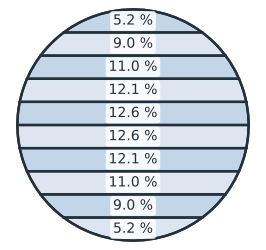
(a) Marks at equal steps of height
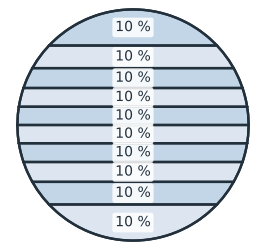
(b) The solved marks: 10 % each
Checks
Three checks follow, none of which is part of the rules. Each solved height is compared with a bisection of the formula in plain Python. The 50 % mark lies on the axis, and the marks are symmetric, so h_k + h_(10−k) = 2r. Finally, the exact Boolean operations of planex2d measure the result independently of the formula: the disc split by the nine solved chords gives ten bands, each a tenth of π r².
[5]:
def area(h, r):
    return r * r * math.acos((r - h) / r) - (r - h) * math.sqrt(2 * r * h - h * h)


def bisect(target, r):
    lo, hi = 0.0, 2.0 * r
    for _ in range(80):
        mid = (lo + hi) / 2
        lo, hi = (mid, hi) if area(mid, r) < target else (lo, mid)
    return (lo + hi) / 2


heights = [tank.Location(f"mark{k}.start")[1] for k in range(1, 10)]
for k, h in enumerate(heights, 1):
    exact = bisect(k / 10 * math.pi * r**2, r)
    print(f"{10 * k:3d} %  h {h:17.12f}, bisection {exact:17.12f}, {h - exact:.1e}")
print("50 % mark - r:", heights[4] - r)
print("symmetry:", max(abs(heights[k] + heights[8 - k] - 2 * r) for k in range(9)))

marks = px.Unify([tank.Edge(f"mark{k}") for k in range(1, 10)])
bands = px.Circle((0, r), r).Face().Split(marks)
share = [b.mass / (math.pi * r**2) for b in bands]
print(len(bands), "bands, largest |share - 0.1|:", max(abs(s - 0.1) for s in share))
 10 %  h  312.951173867459, bisection  312.951173867459, -5.7e-14
 20 %  h  508.138167236290, bisection  508.138167236290, 0.0e+00
 30 %  h  680.308490209496, bisection  680.308490209496, -3.4e-13
 40 %  h  842.263806199984, bisection  842.263806199984, -3.4e-13
 50 %  h 1000.000000000000, bisection 1000.000000000000, 1.1e-13
 60 %  h 1157.736193800016, bisection 1157.736193800016, -2.3e-13
 70 %  h 1319.691509790504, bisection 1319.691509790503, 2.3e-13
 80 %  h 1491.861832763710, bisection 1491.861832763710, 0.0e+00
 90 %  h 1687.048826132540, bisection 1687.048826132540, -4.5e-13
50 % mark - r: -1.1368683772161603e-13
symmetry: 9.094947017729282e-13
10 bands, largest |share - 0.1|: 2.498001805406602e-16
The dipstick
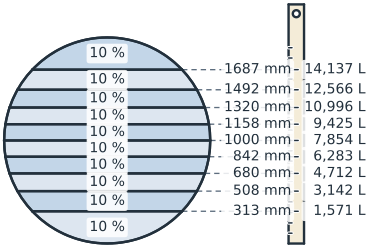
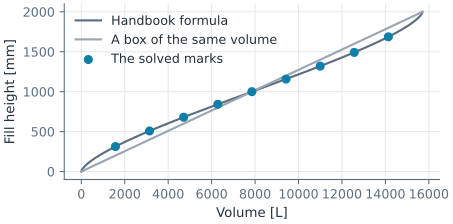
The tank is 5 m long, so every band holds a tenth of π r² times the length. The dipstick stands next to the tank at the same scale, with its foot on the bottom of the shell. It has a long tick at every solved mark, with the volume below it in liters on one side and its height in millimeters on the other, and a short tick every 100 mm. The chart shows why the marks cannot be spaced evenly. The fill height over the volume is the handbook formula turned around: steep at the bottom and the top, and flat in the middle, where a liter adds the least height.
One number changes the tank
The radius is a dimension, and the rules refer to r, so a larger tank takes a single Update, and every mark follows. A circle scales as a whole, so each height grows by exactly the ratio of the radii, and each band still holds a tenth.
[8]:
before = tank.Copy()
tank.Update({"r": 1250})
R = tank["r"]
grown = [tank.Location(f"mark{k}.start")[1] for k in range(1, 10)]
worst = max(abs(b - 1.25 * a) for a, b in zip(heights, grown))
print("largest |h - 1.25 h_before|:", worst)
marks = px.Unify([tank.Edge(f"mark{k}") for k in range(1, 10)])
bands = px.Circle((0, R), R).Face().Split(marks)
share = [b.mass / (math.pi * R**2) for b in bands]
print(len(bands), "bands, largest |share - 0.1|:", max(abs(s - 0.1) for s in share))
largest |h - 1.25 h_before|: 6.821210263296962e-13
10 bands, largest |share - 0.1|: 1.8041124150158794e-16
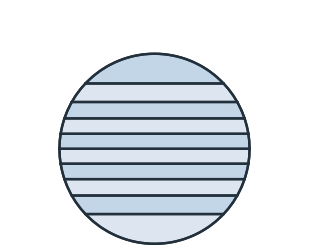
(a) r = 1000
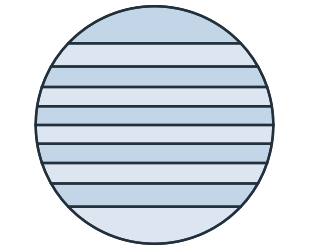
(b) Update({"r": 1250})
The same works for any formula an engineer looks up rather than derives: write it once as a rule, place one element per value it must take, and the sketch solves them together. More rules between dimensions and the geometry: expressions.