Jansen linkage: the Strandbeest leg
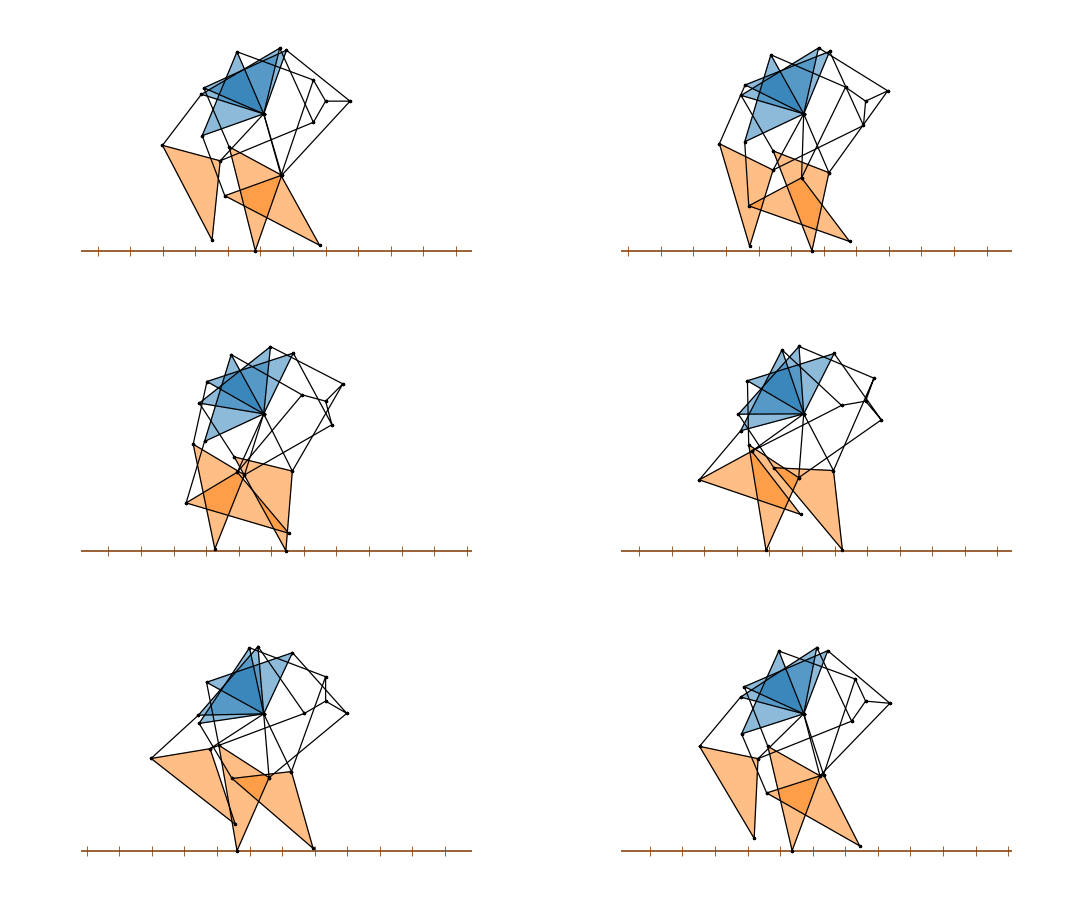
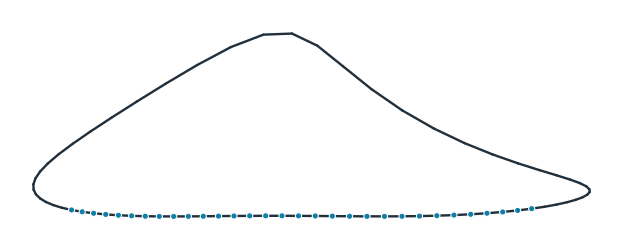
The example is the leg of Theo Jansen’s Strandbeest, the wind-driven beach walker. It has eleven links on one crank, with the lengths that Jansen found by evolving them in a computer, his “holy numbers”. For every crank angle, each joint sits where two circles meet, one around each joint it is linked to, so a position is a chain of circle intersections. The foot runs along a path with a nearly flat bottom, and that part is the step on the ground.
[1]:
import math
import matplotlib.pyplot as plt
from matplotlib.animation import FuncAnimation
from IPython.display import HTML
import planex as px
The holy numbers
The crank pin Z turns around the axle O, and Y is the fixed pivot on the frame, at (−38, −7.8) from the axle. Jansen names the lengths with letters:
Link |
Jansen’s letter |
Length |
|---|---|---|
O–Z, the crank |
m |
15 |
Z–X |
j |
50 |
Y–X |
b |
41.5 |
Z–W |
k |
61.9 |
Y–W |
c |
39.3 |
Y–V |
d |
40.1 |
X–V |
e |
55.8 |
V–U |
f |
39.4 |
W–U |
g |
36.7 |
U–T |
h |
65.7 |
W–T |
i |
49 |
The offsets of Y are his a = 38 and l = 7.8.
[3]:
Y = (-38, -7.8)
links = {("O", "Z"): 15, ("Z", "X"): 50, ("Y", "X"): 41.5, ("Z", "W"): 61.9, ("Y", "W"): 39.3, ("Y", "V"): 40.1,
         ("X", "V"): 55.8, ("V", "U"): 39.4, ("W", "U"): 36.7, ("U", "T"): 65.7, ("W", "T"): 49}
One position
The upper rocker joint X and the lower one W hang between the crank pin and Y, the rigid triangle Y-X-V and the knee U follow, and the foot T is the tip of the rigid triangle W-U-T. Of the two intersections of each pair of circles, one is the leg as built (Figure 1).
[4]:
def meet(p, r, q, s):
    return [(v.x, v.y) for v in px.Circle(p, r).Intersections(px.Circle(q, s))]


def leg(theta):
    t = math.radians(theta)
    Z = (15 * math.cos(t), 15 * math.sin(t))
    X = max(meet(Z, links["Z", "X"], Y, links["Y", "X"]), key=lambda p: p[1])
    W = min(meet(Z, links["Z", "W"], Y, links["Y", "W"]), key=lambda p: p[1])
    V = min(meet(Y, links["Y", "V"], X, links["X", "V"]), key=lambda p: p[0])
    U = min(meet(V, links["V", "U"], W, links["W", "U"]), key=lambda p: p[0])
    T = min(meet(W, links["W", "T"], U, links["U", "T"]), key=lambda p: p[1])
    return {"O": (0, 0), "Y": Y, "Z": Z, "X": X, "W": W, "V": V, "U": U, "T": T}


def sketch(joints):
    s = px.QuickSketch()
    for p, q in links:
        s.Move(joints[p]).Line(joints[q], id=p + q)
    return s
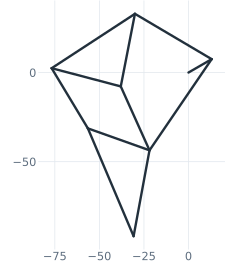
Check: every link keeps its length in all 72 positions of a crank turn:
[6]:
angles = list(range(0, 360, 5))
legs = [leg(theta) for theta in angles]
worst = max(abs(math.dist(joints[p], joints[q]) - length) for joints in legs for (p, q), length in links.items())
print("largest change of a link length", worst)
largest change of a link length 4.263256414560601e-14
The foot
The foot is on the ground while it is close to its lowest point. There, it moves backwards relative to the frame at a nearly steady speed, which pushes the walker forward. The step is the length of that flat stretch, and the lift is how high the foot rises in between. Here, the foot counts as on the ground while it is less than 1 above its lowest point (the dots in Figure 2).
[7]:
foot = [joints["T"] for joints in legs]
low = min(y for x, y in foot)
ground = [n for n, (x, y) in enumerate(foot) if y < low + 1.0]
stride = max(foot[n][0] for n in ground) - min(foot[n][0] for n in ground)
print("on the ground for", len(ground), "of", len(foot), "positions")
print("step", round(stride, 1), "lift", round(max(y for x, y in foot) - low, 1))
on the ground for 31 of 72 positions
step 56.1 lift 22.3
Walking
Three legs sit on one crank, a third of a turn apart, so one is always on the ground. The frame moves forward at the speed at which the grounded foot moves back, so a foot that touches the ground stays where it is until it lifts. How far it still slips shows how flat the step is.
[9]:
first = next(n for n in ground if (n - 1) % len(foot) not in ground)
stance = sorted(ground, key=lambda n: (n - first) % len(foot))
turned = [5 * ((n - first) % len(foot)) for n in stance]
ground_speed = (foot[stance[-1]][0] - foot[stance[0]][0]) / (turned[-1] - turned[0])
slid = [foot[n][0] - ground_speed * t for n, t in zip(stance, turned)]
print("a grounded foot slips by", round(max(slid) - min(slid), 2), "over a step of", round(stride, 1))
a grounded foot slips by 2.86 over a step of 56.1
Three legs walking, a third of a crank turn apart:
[10]: