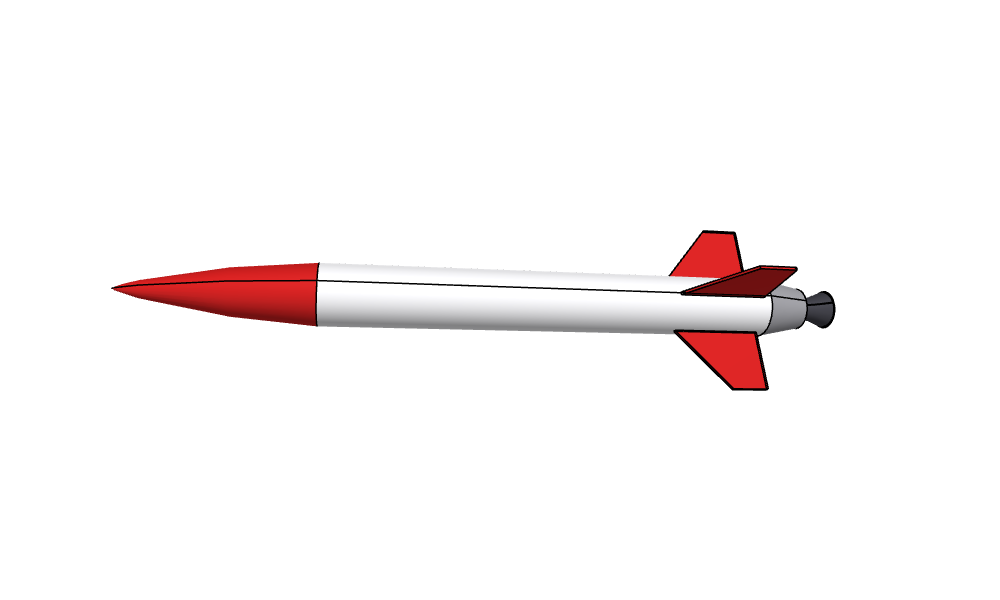
Model rocket: von Kármán nose cone and swept fins
The example is a model rocket with a body tube of radius R = 20 and 300 long, a von Kármán nose cone nose = 120 long, a boat tail of 30 with the nozzle, and four swept fins. The nose is the Haack curve r = R/√π √(θ − sin 2θ / 2), x = L (1 − cos θ)/2, drawn as a spline on the plane of symmetry and revolved. The fins are sketched on that plane, turned about the axis. Lengths are in mm.

[1]:
import math
import netgen.occ as occ
from ngsolve_webgpu.jupyter import Draw
import planex as px
Nose cone
Every part is drawn on side, the plane of symmetry, and revolved about the x axis. The points of the nose sit more densely towards the pointed tip, where the curve bends most. The spline leaves the tip along the axis of symmetry and meets the tube level by itself (Figure 1).
[3]:
R = 20.0
nose = 120.0
side = px.Plane(normal=(0, -1, 0), axis=(1, 0, 0))
axis = occ.Axis((0, 0, 0), occ.X)


def haack(x):
    theta = math.acos(1 - 2 * x / nose)
    return R / math.sqrt(math.pi) * math.sqrt(theta - math.sin(2 * theta) / 2)


points = [(nose * (k / 40) ** 2, haack(nose * (k / 40) ** 2)) for k in range(1, 41)]
profile = px.QuickSketch(side).Spline(points, tangents={0: (0, 1)}, name="haack").Line((nose, 0)).Close()
cone = profile.Face().ToOCCFace().Revolve(axis, 360)
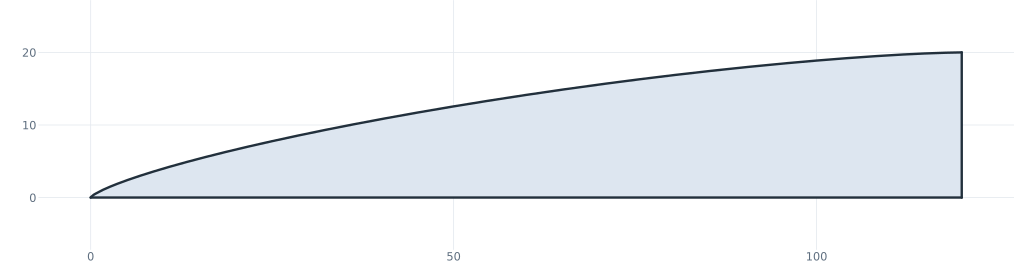
Check: the von Kármán nose has the volume π R² L / 2, and the revolved spline comes close to it:
[5]:
print("nose volume", cone.mass, "exact", math.pi * R**2 * nose / 2)
nose volume 75396.23397473701 exact 75398.22368615503
Body, boat tail, nozzle
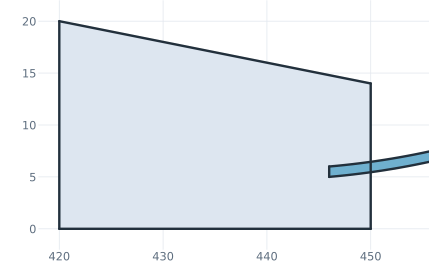
The tube is a rectangle of 300 × R, revolved. The boat tail narrows to 0.7 R over its 30, and the nozzle bell is a wall of two splines, from 4 inside the boat tail to 22 beyond it (Figure 2).
[6]:
end = nose + 300
tube = px.QuickSketch(side).Move((nose, 0)).Rectangle(300, R).Face().ToOCCFace().Revolve(axis, 360)
taper = px.QuickSketch(side).Move((end, 0)).Line((end, R)).Line((end + 30, 0.7 * R)).Line((end + 30, 0)).Close()
boat_tail = taper.Face().ToOCCFace().Revolve(axis, 360)
nozzle = px.QuickSketch(side).Move((end + 26, 5)).Spline([(end + 38, 7), (end + 52, 12)]).Line((end + 52, 13))
nozzle.Spline([(end + 38, 8), (end + 26, 6)]).Close()
bell = nozzle.Face().ToOCCFace().Revolve(axis, 360)
Fins
Each fin is a trapezoid with a root chord of c_root = 60, a tip chord of c_tip = 25 and a span of span = 40, swept back by 35. It is drawn on the plane of symmetry, moved half the fin thickness of 2 off it and extruded through, with its root 1 inside the tube, and it ends 5 before the boat tail. The four fins sit on that plane, turned by 90° each (Figure 3).
[8]:
c_root = 60.0
c_tip = 25.0
span = 40.0
x_f = end - c_root - 5


def fin(angle):
    plane = side.Rotated((0, 0, 0), (1, 0, 0), angle).Offset(-1)
    sketch = px.QuickSketch(plane).Move((x_f, R - 1)).Line((x_f + 35, R + span)).Line((x_f + 35 + c_tip, R + span))
    return sketch.Line((x_f + c_root, R - 1)).Close().Face()


fins = [fin(90 * k) for k in range(4)]
fin_solids = [f.ToOCCFace().Extrude(2) for f in fins]
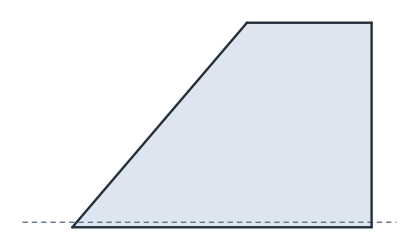
Check: the fin is a trapezoid of the mean chord times its span plus the 1 inside the tube:
[10]:
print("fin area", fins[0].mass, "trapezoid", (c_root + c_tip) / 2 * (span + 1))
fin area 1742.5 trapezoid 1742.5
The rocket
The nose and the fins are red, the tube white, the boat tail gray and the nozzle dark:
[11]:
parts = [(cone, (0.80, 0.12, 0.12)), (tube, (0.95, 0.95, 0.96)), (boat_tail, (0.6, 0.6, 0.62)),
         (bell, (0.25, 0.25, 0.28))]
parts += [(f, (0.80, 0.12, 0.12)) for f in fin_solids]
for shape, color in parts:
    shape.faces.col = color
Draw(occ.Compound([shape for shape, color in parts]), euler_angles=[-24.97, 10.41, 2.95])