Wankel engine: housing, rotor and chambers
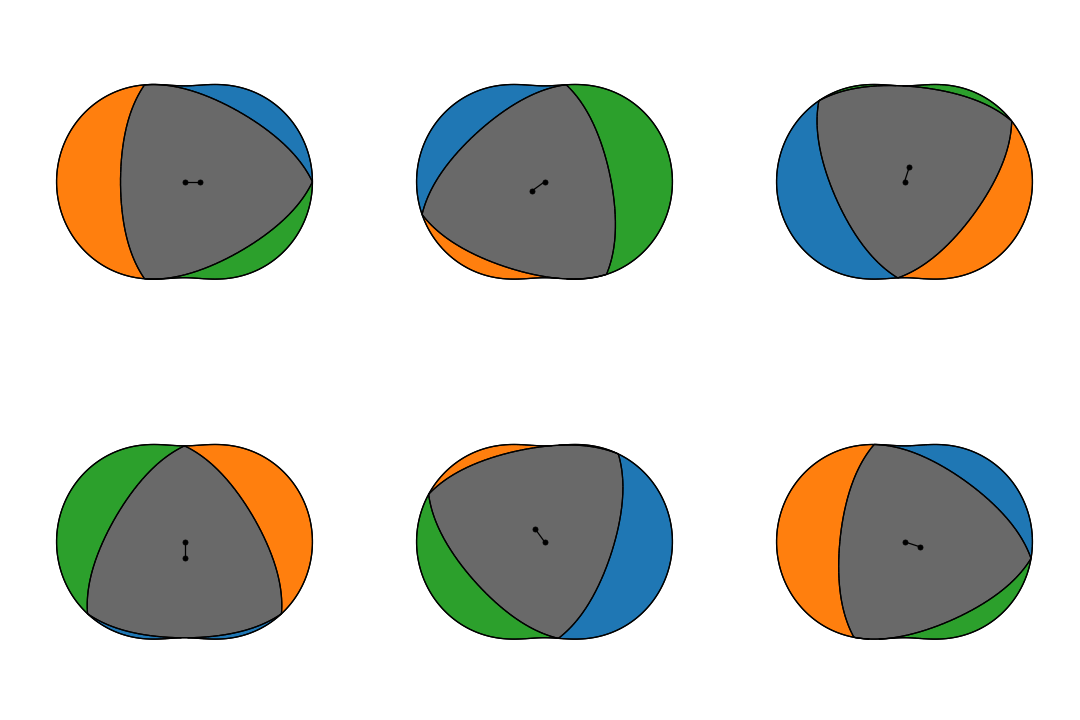
The example is a Wankel engine with the numbers of Mazda’s 13B: a generating radius R = 105, an eccentricity e = 15 and a rotor width of 80. The housing of the rotary engine is an epitrochoid. The triangular rotor turns on an eccentric at a third of the shaft speed, and its three flanks close three chambers that each grow and shrink twice per rotor turn. The rotor is made with Boolean operations as whatever fits inside the housing in every position. Its chambers come out of the housing
minus the rotor, and their change in area times the width is the engine’s displacement per chamber, with the change in area 3√3 R e. Lengths are in mm.
[1]:
import math
import matplotlib.pyplot as plt
from matplotlib.animation import FuncAnimation
from IPython.display import HTML
import planex as px
The housing
The housing is the epitrochoid x = e cos 3α + R cos α, y = e sin 3α + R sin α, drawn as one periodic spline through 240 of its points. Check: its area is π (R² + 3 e²).
[3]:
R = 105.0
e = 15.0
angles = [2 * math.pi * n / 240 for n in range(240)]
points = [(e * math.cos(3 * t) + R * math.cos(t), e * math.sin(3 * t) + R * math.sin(t)) for t in angles]
housing = px.Face([px.Spline(points, periodic=True)])
print("area", housing.mass, "exact", math.pi * (R**2 + 3 * e**2))
area 36756.63395917995 exact 36756.63404700058
The rotor
The rotor’s center runs on a circle of radius e while the rotor turns a third as fast as the shaft, so it turns once in three shaft turns. Seen from the rotor, the housing moves, and the rotor is the intersection of all those views, here 180 of them over the three shaft turns (Figure 1).
[4]:
def from_rotor(shaft):
    t = math.radians(shaft)
    return housing.Translated((-e * math.cos(t), -e * math.sin(t))).Rotated((0, 0), -shaft / 3)


rotor = px.Intersect([from_rotor(3 * 360 * n / 180) for n in range(180)])
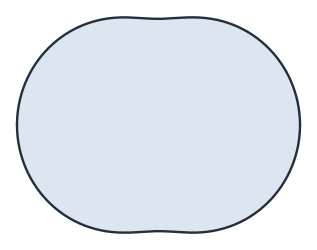
(a) The housing
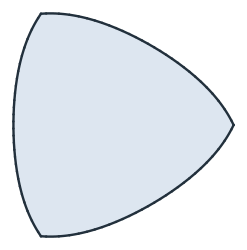
(b) The rotor
Check: the rotor’s apexes run along the housing, so the more views there are, the closer they come to R from the rotor’s center. With 180 views, they fall short of it by a fraction of a micrometer:
[6]:
(x0, y0), (x1, y1) = rotor.bounding_box
print("rotor area", round(rotor.mass, 2), "reaches out to", x1, "R", R)
rotor area 23065.27 reaches out to 104.99983877612173 R 105.0
The chambers
At each shaft angle, the housing minus the placed rotor, cut by the three rays from the rotor’s center through its apexes, gives the three chambers. A chamber goes through its cycle in three shaft turns, and by symmetry, the three chambers over one turn are equivalent to one chamber over three turns.
[7]:
def place(shaft):
    t = math.radians(shaft)
    center = (e * math.cos(t), e * math.sin(t))
    return rotor.Rotated((0, 0), shaft / 3).Translated(center), center


def chambers(shaft):
    body, center = place(shaft)
    gap = housing - body
    pieces = []
    for n in range(3):
        a0, a1 = (math.radians(shaft / 3 + 120 * q) for q in (n, n + 1))
        ray0 = (center[0] + 3 * R * math.cos(a0), center[1] + 3 * R * math.sin(a0))
        ray1 = (center[0] + 3 * R * math.cos(a1), center[1] + 3 * R * math.sin(a1))
        wedge = px.QuickSketch(center).Line(ray0).Line(ray1).Close().Face()
        pieces.append(gap * wedge)
    return pieces, gap


shafts = [3 * n for n in range(120)]
areas = [[piece.mass for piece in chambers(shaft)[0]] for shaft in shafts]
cycle = [a[0] for a in areas] + [a[1] for a in areas] + [a[2] for a in areas]
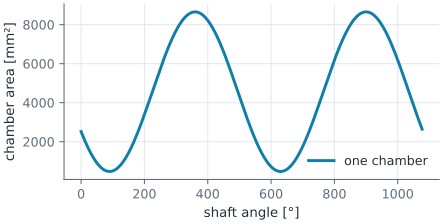
Check: the chamber area changes by 3√3 R e. Times the width of 80, that is the displacement per chamber. The compression ratio leaves out the recess that real rotors have in each flank.
[9]:
swing = max(cycle) - min(cycle)
print("chamber area from", round(min(cycle), 2), "to", round(max(cycle), 2), "mm²")
print("change", swing, "exact", 3 * math.sqrt(3) * R * e)
print("displacement per chamber", round(swing * 80 / 1000, 1), "cm³")
print("compression ratio", round(max(cycle) / min(cycle), 1))
chamber area from 471.82 to 8655.76 mm²
change 8183.940101464743 exact 8183.940065762946
displacement per chamber 654.7 cm³
compression ratio 18.3
In motion
One full cycle of a chamber takes three shaft turns. The animation shows the three chambers in their colors, and the eccentric as a line from the shaft to the rotor’s center.
[10]: