Straight-line linkages: Watt, Chebyshev, Peaucellier-Lipkin
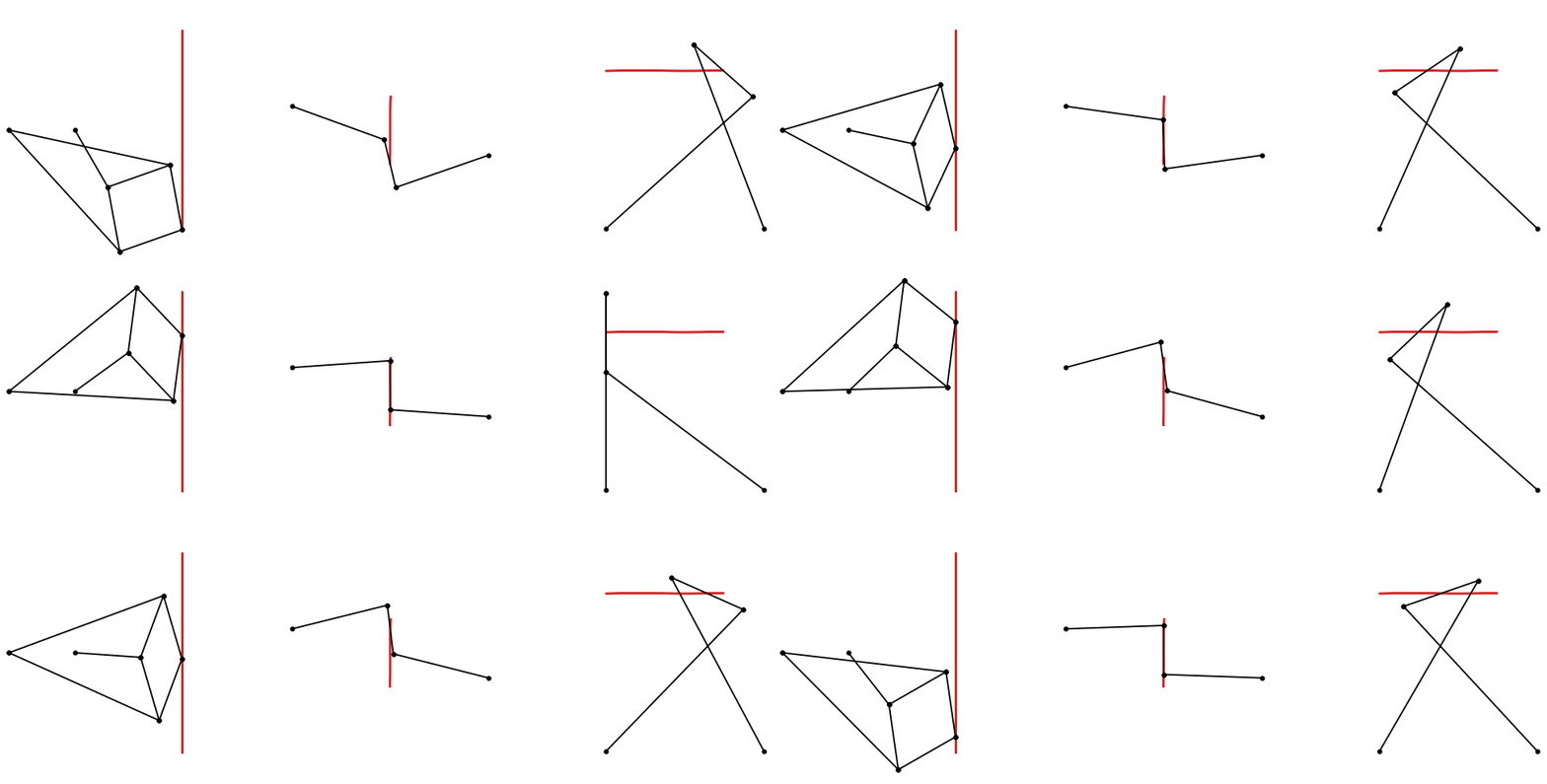
Before precise guideways, a straight motion had to come from links and pins. The example is three linkages that make one: Watt’s linkage and Chebyshev’s give a nearly straight line, and in 1864, Peaucellier and Lipkin found a linkage whose point moves on an exactly straight line. Every position is a chain of circle intersections, and the deviation from the straight line is measured.
[1]:
import math
import matplotlib.pyplot as plt
from matplotlib.animation import FuncAnimation
from IPython.display import HTML
import planex as px
meet gives the points where two circles meet, a circle of radius r around p and one of radius s around q:
[3]:
def meet(p, r, q, s):
    return [(v.x, v.y) for v in px.Circle(p, r).Intersections(px.Circle(q, s))]
Peaucellier-Lipkin
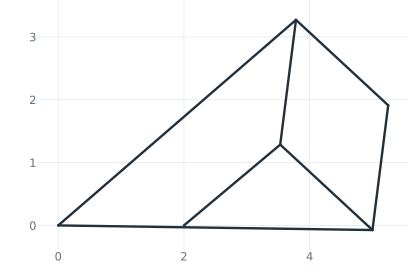
In the Peaucellier-Lipkin linkage, two long arms L from the fixed pivot O hold a rhombus of side s at its corners A and B. The rhombus’s corner C is driven on a circle through O, and the opposite corner P lies at the distance (L² − s²) / OC from O on the same ray. This is an inversion, which turns the circle through O into a straight line at x = (L² − s²) / (2 r). Here, the driving circle has a radius r = 2, the arms are L = 5 long and the rhombus has sides of s = 2 (Figure 1).
[4]:
r = 2.0
L = 5.0
s = 2.0
bars = [("Q", "C"), ("O", "A"), ("O", "B"), ("A", "C"), ("B", "C"), ("A", "P"), ("B", "P")]


def peaucellier(angle):
    t = math.radians(angle)
    C = (r * (1 + math.cos(t)), r * math.sin(t))
    A, B = meet((0, 0), L, C, s)
    P = max(meet(A, s, B, s), key=lambda q: q[0])
    return {"O": (0, 0), "Q": (r, 0), "C": C, "A": A, "B": B, "P": P}


cell = peaucellier(40)
sketch = px.QuickSketch()
for u, w in bars:
    sketch.Move(cell[u]).Line(cell[w], id=u + w)
Watt and Chebyshev
Two linkages give a nearly straight line from four bars:
Watt’s linkage has two equal bars of 2 pointing at each other from two pivots, joined by a coupler of 1 whose middle moves nearly straight;
Chebyshev’s linkage has two crossed bars of 2.5 on a base of 2, joined by a coupler of 1, whose middle also moves nearly straight.
[6]:
def watt(angle, bar=2.0, coupler=1.0):
    t = math.radians(angle)
    left = (-bar, coupler / 2)
    right = (bar, -coupler / 2)
    A = (left[0] + bar * math.cos(t), left[1] + bar * math.sin(t))
    B = min(meet(right, bar, A, coupler), key=lambda q: q[0])
    return {"left": left, "right": right, "A": A, "B": B, "P": ((A[0] + B[0]) / 2, (A[1] + B[1]) / 2)}


def chebyshev(angle):
    t = math.radians(angle)
    A = (2.5 * math.cos(t), 2.5 * math.sin(t))
    B = min(meet((2.0, 0.0), 2.5, A, 1.0), key=lambda q: q[0])
    return {"left": (0.0, 0.0), "right": (2.0, 0.0), "A": A, "B": B, "P": ((A[0] + B[0]) / 2, (A[1] + B[1]) / 2)}
How straight
For each linkage, over a comparable stroke of its point, the deviation is how far the point strays across the stroke from where it started. The Peaucellier-Lipkin linkage and Watt’s move along y, Chebyshev’s along x.
[7]:
def deviation(points, across):
    return max(abs(q[across] - points[0][across]) for q in points)


strokes = {
    "Peaucellier-Lipkin": ([peaucellier(angle)["P"] for angle in range(-60, 61, 2)], 0),
    "Watt": ([watt(angle)["P"] for angle in range(-20, 21)], 0),
    "Chebyshev": ([chebyshev(angle)["P"] for angle in range(42, 91)], 1),
}
for name, (points, across) in strokes.items():
    length = max(q[1 - across] for q in points) - min(q[1 - across] for q in points)
    print(name, "stroke", round(length, 3), "deviation", deviation(points, across))
Peaucellier-Lipkin stroke 6.062 deviation 7.105427357601002e-15
Watt stroke 1.371 deviation 0.010938477390811704
Chebyshev stroke 1.484 deviation 0.004401804672808485
Check: the Peaucellier-Lipkin linkage’s line lies at x = (L² − s²) / (2 r):
[8]:
print("Peaucellier line at x", strokes["Peaucellier-Lipkin"][0][0][0], "formula", (L**2 - s**2) / (2 * r))
Peaucellier line at x 5.25 formula 5.25
In motion
The three linkages, with the paths of their points:
[9]: