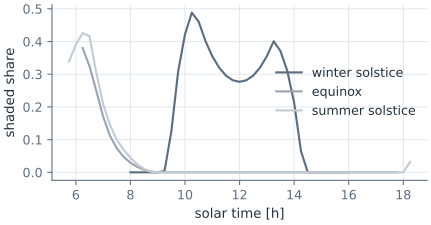
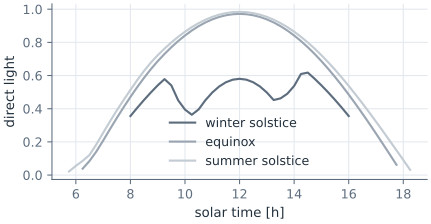
Solar panel shading over a day
The example is a solar panel of 3 × 2 on a roof, with a chimney beside it and a neighbor’s wall to the south. Seen from the sun, everything is flat. Projected along the sun’s direction onto a plane, the panel and the obstacles become planex2d faces, and the part of the panel covered by obstacles is in the shade. The example follows this over a day, hour by hour, at the solstices and the equinox. Lengths are in m.

[1]:
import math
import warnings
import matplotlib.pyplot as plt
import netgen.occ as occ
from ngsolve_webgpu.jupyter import Draw
import planex as px
The scene
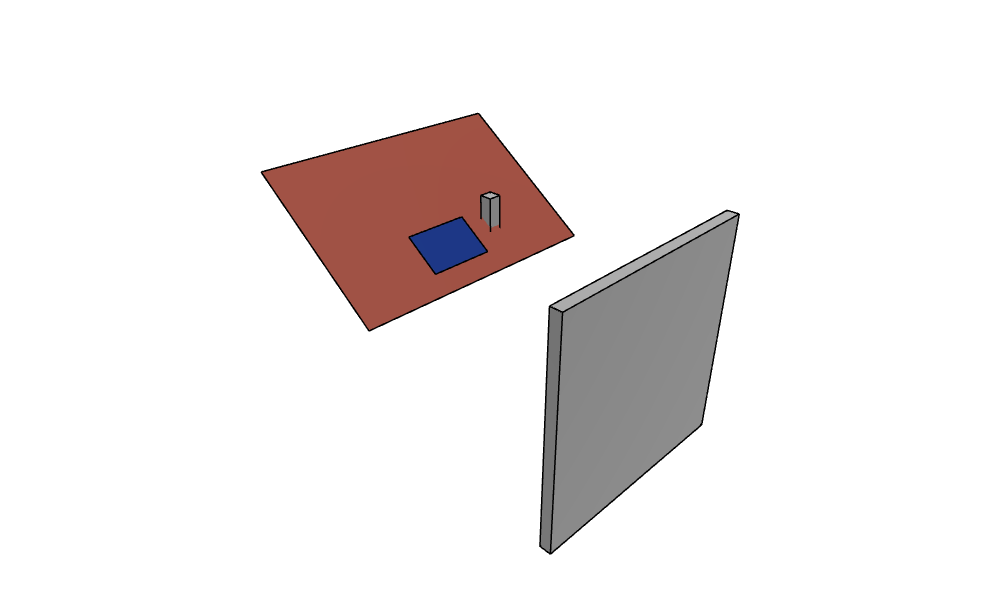
The roof is inclined 35° towards the south (x east, y north, z up). on_roof gives a point on the roof, u along the eaves and v up the slope, lifted off it by lift. The scene:
the roof, 12 wide and 8 up the slope;
the panel, 3 × 2, 1 up the slope and 0.05 above the roof;
the chimney, 0.6 × 0.6, on the roof east of the panel;
the wall, 10 long and 0.5 thick, 8 m to the south.
The roof and the panel are planex2d rectangles on planes along the roof, and the chimney and the wall are boxes. Only the parts of the obstacles above the roof can shade the panel.
[3]:
tilt = math.radians(35)
up_slope = (0.0, math.cos(tilt), math.sin(tilt))
normal = (0.0, -math.sin(tilt), math.cos(tilt))


def on_roof(u, v, lift=0.0):
    return (u, v * up_slope[1] + lift * normal[1], v * up_slope[2] + lift * normal[2])


roof = px.QuickSketch(px.Plane(origin=on_roof(-4, 0), normal=normal, axis=(1, 0, 0))).Rectangle(12, 8)
roof = roof.Face().ToOCCFace()
panel = px.QuickSketch(px.Plane(origin=on_roof(0, 1, 0.05), normal=normal, axis=(1, 0, 0))).Rectangle(3, 2)
panel = panel.Face().ToOCCFace()
base = on_roof(4.0, 2.0)
chimney = occ.Box(occ.Pnt(base[0], base[1], base[2] - 0.5), occ.Pnt(base[0] + 0.6, base[1] + 0.6, base[2] + 1.4))
wall = occ.Box(occ.Pnt(-3, -8.5, -6), occ.Pnt(7, -8, 4.0))
above = occ.Box(occ.Pnt(-50, -50, 0), occ.Pnt(50, 50, 50)).Rotate(occ.Axis((0, 0, 0), occ.X), 35)
obstacles = [chimney * above, wall * above]
roof.faces.col = (0.6, 0.3, 0.25)
panel.faces.col = (0.1, 0.2, 0.5)
Draw(occ.Compound([roof, panel, chimney, wall]))
The sun
The location is Vienna, at latitude 48.2°. The sun’s elevation and direction follow from the day’s declination and the hour angle (solar time).
[4]:
latitude = math.radians(48.2)

def sun(day, hour):
    declination = math.radians(23.44) * math.sin(2 * math.pi * (284 + day) / 365)
    H = math.radians(15 * (hour - 12))
    elevation = math.asin(math.sin(latitude) * math.sin(declination)
                          + math.cos(latitude) * math.cos(declination) * math.cos(H))
    east = -math.cos(declination) * math.sin(H)
    north = math.cos(latitude) * math.sin(declination) - math.sin(latitude) * math.cos(declination) * math.cos(H)
    return (east, north, math.sin(elevation)), math.degrees(elevation)
Seen from the sun
The view plane faces the sun. flat projects every face of an obstacle onto it and unites them, and the share of the panel’s projection that the obstacles cover is the shaded share of the panel.
[5]:
def view(direction):
    d = direction
    h = (-d[1], d[0], 0.0) if abs(d[2]) < 0.99 else (1.0, 0.0, 0.0)
    return px.Plane(normal=d, axis=h)


def flat(shape, axes):
    pieces = []
    for f in shape.faces:
        try:
            with warnings.catch_warnings():
                warnings.simplefilter("ignore", px.PlanexWarning)
                piece = px.Face(px.Project(f, axes))
        except Exception:
            continue
        if piece.mass > 1e-9:
            pieces.append(piece)
    return px.Unify(pieces) if pieces else None


def shade(direction):
    axes = view(direction)
    target = px.Face(px.Project(panel, axes))
    covers = [c for c in (flat(o, axes) for o in obstacles) if c is not None]
    covered = (target * px.Unify(covers)).mass if covers else 0.0
    return target, covers, covered / target.mass
Check: projected onto the view plane, the panel keeps its area of 6 m² times the cosine of the sun’s angle to the panel. At the equinox at 10:00 (solar time):
[6]:
direction, elevation = sun(80, 10.0)
target, covers, shaded = shade(direction)
cosine = sum(a * b for a, b in zip(direction, normal)) / math.hypot(*direction)
print("sun", round(elevation, 1), "degrees high, panel seen from the sun", target.mass, "m², 6 m² times cos",
      6 * cosine, "m²")
print("shaded", round(100 * shaded, 1), "%")
sun 34.9 degrees high, panel seen from the sun 5.049090637440053 m², 6 m² times cos 5.0490906374400515 m²
shaded 0.0 %
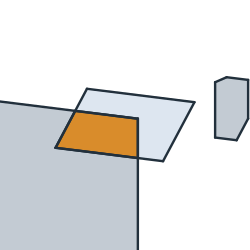
At 10:00 at the equinox, the obstacles miss the panel. At the winter solstice, with the sun low, the wall’s shadow covers much of it in the morning (Figure 1).
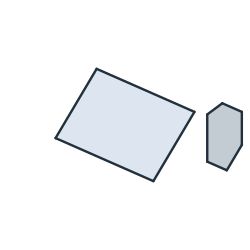
(a) Equinox, 10:00: 0 % shaded
(b) Winter solstice, 10:00: 42 % shaded
Over the day
Every quarter of an hour from 4:00 to 20:00 while the sun shines on the panel, the shaded share and the sunlight that the panel catches are recorded: the cosine of the sun’s angle times the unshaded share. The loss compares that with the same panel without obstacles:
[8]:
days = {"winter solstice": 355, "equinox": 80, "summer solstice": 172}
curves = {}
for label, day in days.items():
    hours, shares, light, clear = [], [], [], []
    for quarter in range(4 * 4, 4 * 20 + 1):
        hour = quarter / 4
        direction, elevation = sun(day, hour)
        cosine = sum(a * b for a, b in zip(direction, normal))
        if elevation <= 0 or cosine <= 0:
            continue
        share = shade(direction)[2]
        hours.append(hour)
        shares.append(share)
        light.append(cosine * (1 - share))
        clear.append(cosine)
    curves[label] = (hours, shares, light)
    print(label, round(100 * (1 - sum(light) / sum(clear)), 1), "% of the day's direct light lost to shade")
winter solstice 22.5 % of the day's direct light lost to shade
equinox 0.9 % of the day's direct light lost to shade
summer solstice 1.6 % of the day's direct light lost to shade