Areas, centroids and second moments
The section properties of a profile, its area, centroid and second moments of area, are what a beam calculation needs. center is the centroid in 3D, and Measure() adds the second moments about it in the plane of the object:
Ih, the integral of v², about the h axis;Iv, the integral of h², about the v axis;Ihv, the product moment, the integral of h v;I1 ≥ I2, the principal second moments, andprincipal_angle, the angle of the first principal axis in degrees.
[1]:
import math
import planex as px
Everything at once
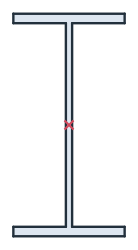
Measure() returns every measurement of an object as a dict. The example is an IPE 200 beam section without its root radii: 200 high and 100 wide, with flanges 8.5 thick and a web 5.6 thick (Figure 1, with the centroid marked).
[3]:
flange = px.QuickSketch().RectangleC(100, 8.5).Face()
web = px.QuickSketch().RectangleC(5.6, 200 - 2 * 8.5).Face()
beam = px.Unify([flange.Translated((0, 95.75)), web, flange.Translated((0, -95.75))])
[5]:
m = beam.Measure()
for key in ["type", "area", "center", "Ih", "Iv", "I1", "I2", "principal_angle", "bounding_box"]:
    print(key, m[key])
type face
area 2724.799999999999
center (-3.337840214962303e-16, -2.002704128977382e-15, 0.0)
Ih 18455902.266666662
Iv 1419344.8106666664
I1 18455902.266666662
I2 1419344.8106666654
principal_angle 6.125728674641656e-33
bounding_box ((-50.0, -100.0), (50.0, 100.0))
Two sections
The first example is a T-slot nut, a flange of 18 × 4 below a neck of 10 × 6, with its centroid marked (Figure 2a). Its half is drawn and mirrored. The centroid of two rectangles lies at v = (A1 v1 + A2 v2) / (A1 + A2).
[6]:
half = px.QuickSketch().Line(9).Line(0, 4).Line(-4, 0).Line(0, 6).Line((0, 10)).Close().Face()
nut = half + half.Mirrored((0, 0), (0, 1))
A1, A2 = 18 * 4, 10 * 6
print("nut centroid", nut.center, "exact v", (A1 * 2 + A2 * (4 + 3)) / (A1 + A2))
nut centroid (1.0765799026668185e-16, 4.2727272727272725, 0.0) exact v 4.2727272727272725
The second example is a sharp-cornered equal angle of 40 × 40 × 5, with its centroid and its principal axes dashed (Figure 2b). The principal axes lie at 45° to the legs. Its second moments follow from the two rectangles about the outer corner, moved to the centroid. With L = 40 and t = 5:
[7]:
L, t = 40, 5
angle = px.QuickSketch().Line(L).Line(0, t).Line(t - L, 0).Line(0, L - t).Line(-t, 0).Close().Face()
m = angle.Measure()

A = t * (2 * L - t)
c = (L**2 + L * t - t**2) / (2 * (2 * L - t))
I = (t * L**3 + (L - t) * t**3) / 3 - A * c**2
Ihv = t**2 * (2 * L**2 - t**2) / 4 - A * c**2
for key, exact in {"area": A, "Ih": I, "Iv": I, "I1": I + abs(Ihv), "I2": I - abs(Ihv)}.items():
    print(key, m[key], "exact", exact)
print("principal angle", m["principal_angle"])
area 375.0 exact 375
Ih 55614.583333333336 exact 55614.58333333333
Iv 55614.583333333336 exact 55614.58333333333
I1 88281.25 exact 88281.25
I2 22947.91666666667 exact 22947.916666666657
principal angle 45.0
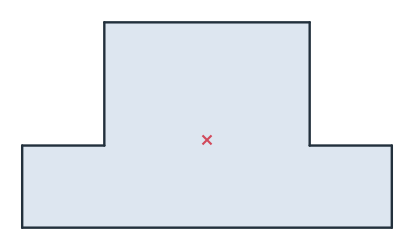
(a) A T-slot nut and its centroid
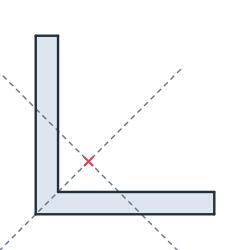
(b) An equal angle and its principal axes