The Hausdorff distance
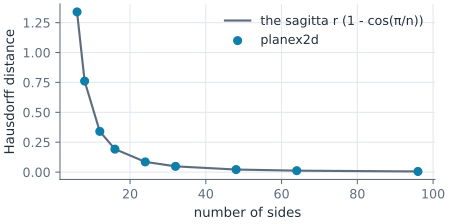
How far does a polygon lie from the circle it stands for? The Hausdorff distance answers it: the largest distance from a point of either curve to the other, so how far apart the two are at their worst. For a regular polygon of \(n\) sides inscribed in a circle of radius \(r\), the worst point is the middle of an arc, and its distance to the chord below it is the sagitta
The same number is the chord tolerance with which a CAD program or a mesh generator turns a circle into segments. Archimedes used polygons of 96 sides around and inside a circle to bound \(\pi\).
px.measurements.Hausdorff(a, b) measures it between two named parts of one object.

[1]:
import math

import planex as px
A polygon in its circle
The circle has a radius of 10, and Polygon draws a regular polygon with its corners on it. Glued together, the circle and the polygon keep their names, and the Hausdorff distance between the two parts follows the sagitta:
[3]:
circle = px.Circle((0, 0), 10)
circle.name = "circle"


def hausdorff(n):
    polygon = px.QuickSketch().Polygon((0, 0), 10, n).Wire()
    polygon.name = "polygon"
    both = px.Glue([circle, polygon])
    return both.Measure(px.measurements.Hausdorff("circle", "polygon")), polygon


for n in (6, 12, 24, 96):
    print("n", n, "| Hausdorff", hausdorff(n)[0], "| sagitta", 10 * (1 - math.cos(math.pi / n)))
n 6 | Hausdorff 1.3397459621556165 | sagitta 1.339745962155613
n 12 | Hausdorff 0.34074173710931777 | sagitta 0.3407417371093169
n 24 | Hausdorff 0.08555138626189761 | sagitta 0.08555138626189618
n 96 | Hausdorff 0.005354125236346173 | sagitta 0.005354125236343155
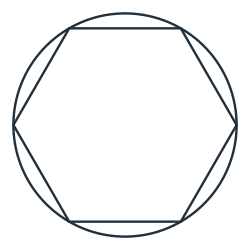
(a) 6 sides
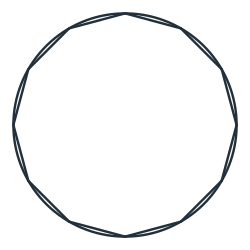
(b) 12 sides
Doubling the sides divides the distance by about four, as \(\pi^2 r / (2 n^2)\) says (Figure 2):
Archimedes’ 96-gons
The polygon of 96 sides inside the circle is shorter than the circle, and the one around it, with its corners at \(r / \cos(\pi/96)\), is longer. Their perimeters bound \(\pi\). Archimedes, bounding the square roots on the way by fractions, stated \(223/71 < \pi < 22/7\), a little wider than the polygons themselves:
[6]:
inside = px.QuickSketch().Polygon((0, 0), 10, 96).Wire()
around = px.QuickSketch().Polygon((0, 0), 10 / math.cos(math.pi / 96), 96).Wire()
print("inside", inside.mass / 20, "| around", around.mass / 20)
print("Archimedes", 223 / 71, "<", math.pi, "<", 22 / 7)
inside 3.1410319508905093 | around 3.1427145996453656
Archimedes 3.140845070422535 < 3.141592653589793 < 3.142857142857143
A chord tolerance
A tessellation goes the other way: from a tolerance to a number of segments. For a chord height of at most \(t\), a circle needs at least \(n = \lceil \pi / \arccos(1 - t/r) \rceil\) segments. Polylines(tol) turns the circle into such a polyline, and its Hausdorff distance from the circle stays within the tolerance:
[7]:
for tol in (0.1, 0.01, 0.001):
    points = circle.Polylines(tol)[0][:-1]
    polyline = px.FromPolyline(points, closed=True)
    polyline.name = "polyline"
    distance = px.Glue([circle, polyline]).Measure(px.measurements.Hausdorff("circle", "polyline"))
    print("tolerance", tol, "| segments", len(points), "| at least", math.ceil(math.pi / math.acos(1 - tol / 10)),
          "| Hausdorff", distance)
tolerance 0.1 | segments 24 | at least 23 | Hausdorff 0.0855513862618975
tolerance 0.01 | segments 72 | at least 71 | Hausdorff 0.009517784181424361
tolerance 0.001 | segments 224 | at least 223 | Hausdorff 0.0009834824042516286