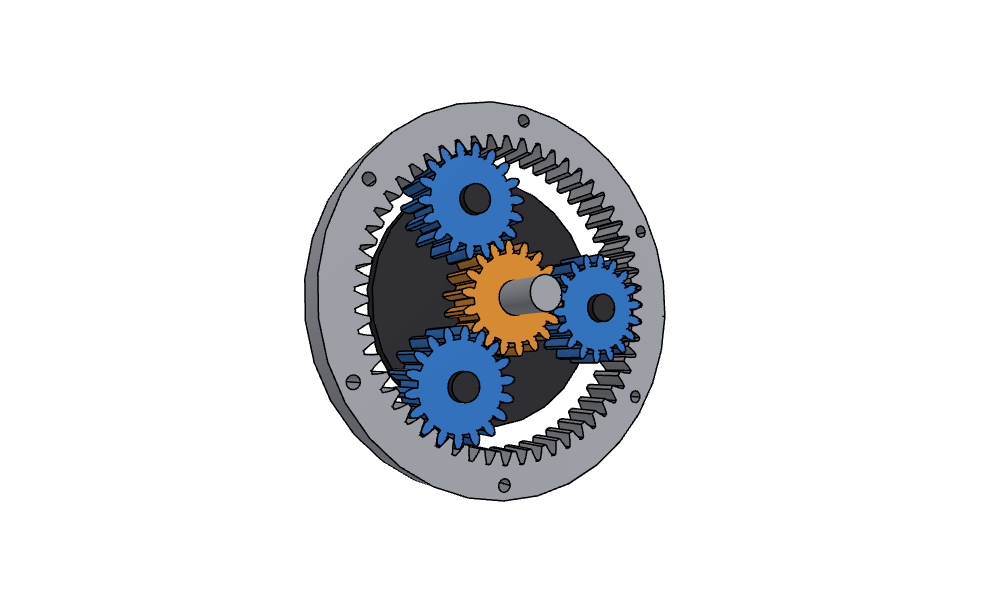
Planetary gearbox: sun, planets and ring gear
The example is a planetary gearbox with a sun of 18 teeth, three planets of 18 and a ring gear of 54, all of module m = 2, with a pressure angle alpha of 20° and 15 wide. The ring is a housing disc minus an external gear whose teeth are the ring’s gaps. Every tooth is slightly thinner than nominal, so the meshes have backlash. Lengths are in

[1]:
import math
import netgen.occ as occ
from ngsolve_webgpu.jupyter import Draw
import planex as px
The tooth counts
Checks: the tooth counts have to fit together:
the planets fill the space between the sun and the ring, so the ring has the sun’s teeth plus two planets’;
the sum of the sun’s and the ring’s teeth divided by the number of planets is whole, so the planets sit at equal angles;
with the ring held, the carrier turns 1 + 54 / 18 = 4 times slower than the sun and carries 4 times its torque.
[3]:
z_sun = 18
z_planet = 18
z_ring = 54
print("ring", z_ring, "sun + 2 planets", z_sun + 2 * z_planet)
print("(sun + ring) / planets", (z_sun + z_ring) / 3)
print("ratio with the ring held", 1 + z_ring / z_sun)
ring 54 sun + 2 planets 54
(sun + ring) / planets 24.0
ratio with the ring held 4.0
The gears
gear is the involute gear of the spur gear example, with the addendum and the dedendum as arguments and flanks that can be made thinner. The planets sit at the center distance a from the sun.
[4]:
m = 2.0
alpha = math.radians(20)
a = m * (z_sun + z_planet) / 2


def inv(t):
    return math.tan(t) - t


def gear(z, addendum=m, dedendum=1.25 * m, thinner=0.0):
    r = m * z / 2
    rb, ra, rf = r * math.cos(alpha), r + addendum, r - dedendum
    beta = math.pi / (2 * z) + inv(alpha) - thinner / r
    ta = math.sqrt((ra / rb) ** 2 - 1)
    flank = []
    for i in range(21):
        t = ta * i / 20
        rt, phi = rb * math.sqrt(1 + t * t), -(beta - inv(math.atan(t)))
        flank.append((rt * math.cos(phi), rt * math.sin(phi)))
    other = [(x, -y) for x, y in flank]
    tip = 2 * math.degrees(beta - inv(math.atan(ta)))
    tooth = px.QuickSketch().Line(flank[0]).Spline(flank[1:]).Arc(center=(0, 0), sweep=tip)
    tooth = tooth.Spline(other[::-1][1:]).Close().Face()
    teeth = [tooth.Rotated((0, 0), 360 * k / z) for k in range(z)]
    return px.Unify(teeth + [px.QuickSketch().Circle(rf).Face()])
The parts
The backlash is 0.1, so each flank is a quarter of it, 0.025, thinner. In the ring, that makes the gaps wider, so its cutter gets thicker teeth. The parts:
the sun, with a bore of 12;
the ring: a housing disc of 136, minus the cutter and six bolt holes of 4.4 on a circle of 126. The cutter is turned by half its pitch, so that the ring’s teeth sit in the planets’ gaps on the outside;
the three planets, with bores of 10. The sun has a tooth pointing at each planet, so each planet is turned by half a tooth pitch to meet it with a gap.
[5]:
def disc(x, y, r):
    return px.QuickSketch().Circle(x, y, r).Face()


sun = gear(z_sun, thinner=0.025) - disc(0, 0, 6)
cutter = gear(z_ring, addendum=1.25 * m, dedendum=m, thinner=-0.025).Rotated((0, 0), 180 / z_ring)
bolts = [disc(63 * math.cos(math.radians(30 + 60 * k)), 63 * math.sin(math.radians(30 + 60 * k)), 2.2) for k in range(6)]
ring = px.Subtract([disc(0, 0, 68), cutter, *bolts])
centers = [(a * math.cos(math.radians(120 * k)), a * math.sin(math.radians(120 * k))) for k in range(3)]
planet_faces = [gear(z_planet, thinner=0.025).Rotated((0, 0), 180 / z_planet).Translated(c) - disc(*c, 5)
                for c in centers]

Check: the meshing parts do not overlap anywhere, and the backlash leaves a gap between the closest flanks:
[7]:
pairs = [(sun, q) for q in planet_faces] + [(ring, q) for q in planet_faces]
print("overlap between meshing parts", max((x * y).mass for x, y in pairs))
print("closest flanks", round(min(x.Distance(y) for x, y in pairs), 4), "mm")
overlap between meshing parts 0.0
closest flanks 0.047 mm
In 3D
The gears are extruded to their width of 15 and joined by a carrier plate 5 thick behind the planets, with the pins through them, and the sun’s shaft.
[8]:
def solid(face, z0, h, col):
    s = face.ToOCCShape().Extrude(h).Move((0, 0, z0))
    s.faces.col = col
    return s


def cylinder(c, r, z0, h, col):
    s = occ.Cylinder(occ.Pnt(c[0], c[1], z0), occ.Z, r, h)
    s.faces.col = col
    return s


colors = {"steel": (0.62, 0.63, 0.66), "brass": (0.85, 0.55, 0.20), "blue": (0.20, 0.45, 0.75),
          "dark": (0.18, 0.18, 0.20)}
carrier = disc(0, 0, a + 9) - disc(0, 0, 8)
gearbox = occ.Compound([
    solid(ring, 0, 15, colors["steel"]),
    solid(sun, 0, 15, colors["brass"]),
    *[solid(q, 0, 15, colors["blue"]) for q in planet_faces],
    solid(carrier, -7, 5, colors["dark"]),
    *[cylinder(c, 5, -7, 25, colors["dark"]) for c in centers],
    cylinder((0, 0), 6, -25, 60, colors["steel"]),
])
Draw(gearbox, euler_angles=[-4.90, 29.47, -3.60])