Boat stability: the righting lever curve
The stability of a boat follows from its cross-section, and the example is a hull section heeled from upright to capsized. When the hull heels and the waterline is found at which it still displaces its weight, the center of buoyancy, the centroid of the part under water, moves sideways. The horizontal distance between it and the center of gravity is the righting lever GZ. Plotted against the heel angle, it shows how stiff the boat is and from which angle it capsizes. All of it is Boolean operations and centroids. Lengths are in m, per meter of hull length.
[1]:
import math
import matplotlib.pyplot as plt
from matplotlib.animation import FuncAnimation
from IPython.display import HTML
import planex as px
The hull
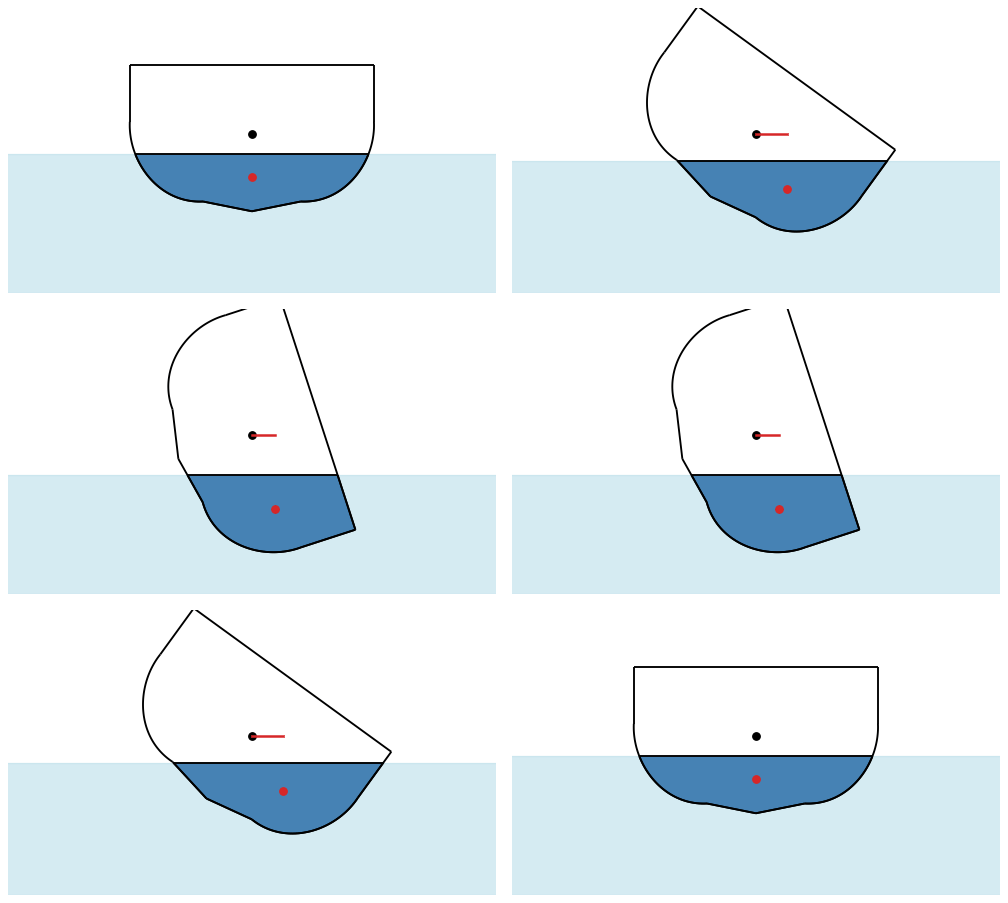
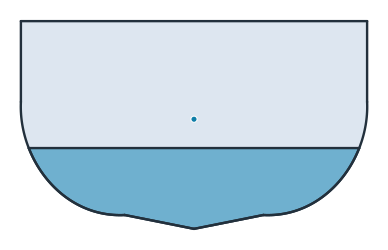
The hull is a round-bilge section, 3 m wide and 1.8 m deep. Half of it is drawn, mirrored and united. Upright, it floats at a draft of 0.7 m, and its center of gravity G lies KG = 0.95 m above the keel (Figure 1). below is everything below a waterline, and the part of the hull under water is the hull times it.
[3]:
half = px.QuickSketch().Line((0.6, 0.12)).Spline([(1.2, 0.35), (1.45, 0.75), (1.5, 1.1)]).Line((1.5, 1.8))
half = half.Line((0, 1.8)).Close().Face()
hull = px.Unify([half, half.Mirrored((0, 0), (0, 1))]).faces[0]
draft = 0.7
KG = 0.95
G = (0.0, KG)


def below(level):
    return px.QuickSketch((-20, -20)).Rectangle(40, level + 20).Face()


displaced = (hull * below(draft)).mass
print("hull area", hull.mass, "m², under water", displaced, "m²")
hull area 4.7623728074753 m², under water 1.4780596282012237 m²
Heeled
The hull turns about its center of gravity, and the waterline then rises or falls until the part under water has the upright area again, which bisection finds. GZ is how far the center of buoyancy lies beside the center of gravity, positive when it rights the boat. The center of buoyancy B is the centroid of the part under water, its center.
[5]:
def heeled(angle):
    body = hull.Rotated(G, -angle)
    low, high = -3.0, 4.0
    for step in range(50):
        level = (low + high) / 2
        if (body * below(level)).mass < displaced:
            low = level
        else:
            high = level
    wet = body * below(level)
    B = wet.center[:2]
    return {"angle": angle, "body": body, "level": level, "wet": wet, "B": B, "GZ": B[0] - G[0]}


curve = [heeled(angle) for angle in range(0, 181, 3)]
best = max(curve, key=lambda s: s["GZ"])
vanishing = next((s["angle"] for s in curve[1:] if s["GZ"] < 0), None)
print("largest righting lever", round(best["GZ"], 3), "m at", best["angle"], "degrees")
print("it rights itself up to", vanishing, "degrees")
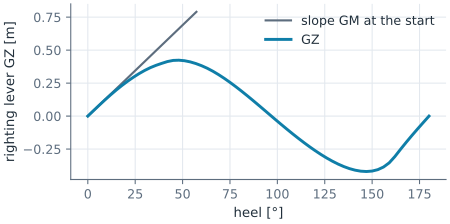
largest righting lever 0.424 m at 48 degrees
it rights itself up to 99 degrees
Check: the metacentric height
For small angles, GZ = GM sin φ. GM is the height of the metacenter above G, KB + BM − KG, where KB is the height of the upright center of buoyancy and BM = I / V, with I the second moment of the waterline (its width cubed over 12 per meter of length) and V the area under water. Check: GZ at a heel of 1° agrees with GM sin 1°:
[6]:
upright = hull * below(draft)
KB = upright.center[1]
crossings = sorted(v.x for v in hull.Intersections(px.Line((-5, draft), (5, draft))))
width = crossings[-1] - crossings[0]
BM = width**3 / 12 / displaced
GM = KB + BM - KG
print("waterline", round(width, 4), "m wide, KB", round(KB, 4), "m, BM", round(BM, 4), "m, GM", round(GM, 4), "m")
print("GZ at 1 degree", round(heeled(1.0)["GZ"], 5), "m, GM sin 1 degree", round(GM * math.sin(math.radians(1)), 5), "m")
waterline 2.8637 m wide, KB 0.4164 m, BM 1.3241 m, GM 0.7905 m
GZ at 1 degree 0.01379 m, GM sin 1 degree 0.0138 m
The righting lever curve starts with the slope GM per radian (Figure 2):
Heeling over
The hull heeling to 90° and back, with G in black and B in red:
[8]: