Splines
In a sketch, Spline(points) runs from the pen through the given points, and lines and arcs join it like any other edge. periodic=True closes it smoothly, and tangents= sets its direction at chosen points. A spline through points interpolates the curve the points come from, so it is close to that curve but not exactly on it. The checks below show how close. See Splines for how planex2d handles splines in general, including the two interpolation styles,
closed splines and points.
[1]:
import math
import numpy as np
import planex as px
A NACA 0012 airfoil
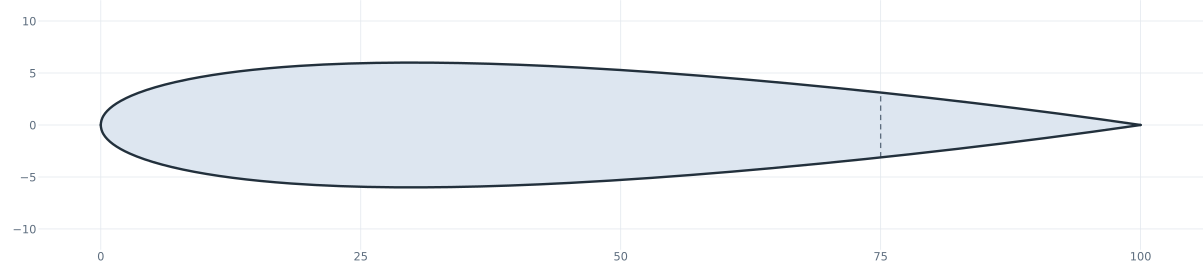
The airfoil has a chord of 100 and a thickness of 12 %, in the form with a closed trailing edge, with 40 points per side and cosine spacing. The angle θ runs once around the profile, from the trailing edge over the upper side to the leading edge and back along the lower side, so the spline starts and ends at the trailing edge. px.FromNACA("0012") creates the same profile in one call. Here it is drawn point by point to show Spline in a sketch.
A construction line at 75 % chord runs from the lower to the upper surface. It is the hinge line of a flap and is as long as the profile is thick there (Figure 1). Its ends are given as (target, point), which selects the intersection with the profile nearest to the point.
[3]:
def thickness(x):
    return 60 * (0.2969 * np.sqrt(x) - 0.1260 * x - 0.3516 * x**2 + 0.2843 * x**3 - 0.1036 * x**4)


theta = np.linspace(0, 2 * np.pi, 81)[1:]
x = (1 + np.cos(theta)) / 2
points = np.column_stack([100 * x, np.sign(np.sin(theta)) * thickness(x)])

wing = px.QuickSketch((100, 0)).Spline(points, id="profile")
wing.Move((75, -100), dir=(0, 1))
wing.Line(("profile", (75, -100)), parallel=px.V, until=("profile", (75, 100)), id="hinge", construction=True)
profile = wing.Face()
The area is checked against the integral of the thickness formula, and the hinge line against the thickness:
[5]:
exact = 12000 * (0.2969 * 2 / 3 - 0.1260 / 2 - 0.3516 / 3 + 0.2843 / 4 - 0.1036 / 5)
print("area", profile.mass, "exact", exact, "relative", (profile.mass - exact) / exact)
print("hinge", wing.Edge("hinge").mass, "thickness", 2 * thickness(0.75))
area 817.0611516356596 exact 817.0599999999997 relative 1.4094872590512479e-06
hinge 6.240877677195613 thickness 6.240878086031979
A closed cam
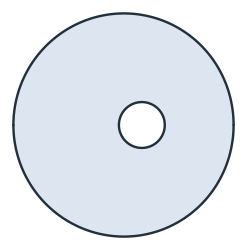
The cam is a periodic spline through the lift curve r = R + h (1 − cos a) / 2 with R = 20 and h = 8 at 36 points, with a bore of 10 (Figure 2). The area of the exact lift curve is π (R + h/2)² + π h²/8, and the spline matches it within the interpolation error:
[6]:
a = np.radians(np.arange(0, 360, 10))
r = 20 + 8 * (1 - np.cos(a)) / 2
lift = px.Spline(np.column_stack([r * np.cos(a), r * np.sin(a)]), periodic=True)
cam = px.Face([lift, px.Circle((0, 0), 5)])
[8]:
exact = math.pi * 24**2 + math.pi * 8**2 / 8 - math.pi * 10**2 / 4
print("area", cam.mass, "exact", exact, "relative", (cam.mass - exact) / exact)
area 1756.1465567096234 exact 1756.1502933566942 relative -2.127749022930798e-06