Displacements and topology changes
Experimental: a proof of concept.
px.DeformableShape(face, h, min_distance) represents a face as dense closed polylines. Every edge is sampled at most h apart, outer loops run counterclockwise and holes clockwise. SetDeformation(d) moves every vertex by its row of the array d, which has one row of two displacements per vertex. When parts of the boundary come closer than min_distance, the shape changes its topology: a hole opens to the outside, and parts merge or split. SetDeformation returns True when
this happens.
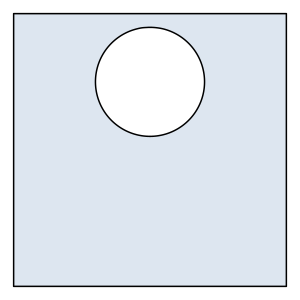
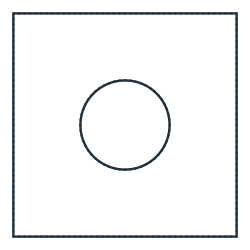
The example is a square plate 2 × 2 with a hole of radius 0.4. The edges are sampled 0.05 apart, and parts of the boundary may come as close as 0.1 (Figure 1).
[1]:
import numpy as np
import planex as px

face = px.QuickSketch().RectangleC(2, 2, name="outer").Circle(0, 0, 0.4, name="hole").Face()
shape = px.DeformableShape(face, h=0.05, min_distance=0.1)
Moving the hole up
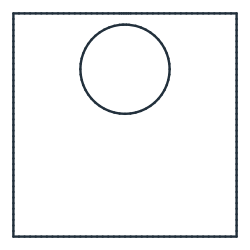
Every vertex keeps the name of the edge it was sampled from, and VertexNames() lists these names in the order of the vertices. The displacement therefore selects the hole by its name and moves it up by 0.02 per step, while the outline stays in place. The loop stops at the first topology change (Figure 2).
[4]:
for step in range(40):
    names = np.array(shape.VertexNames())
    d = np.zeros((len(shape), 2))
    d[names == "hole", 1] = 0.02
    if shape.SetDeformation(d):
        print("topology changed at step", step)
        break
topology changed at step 24
What happens at a topology change
The picture shows the top edge enlarged, in a run with smaller steps. The outline is black, the hole green and the new edges red. At step 120, the top of the hole comes closer to the outline than min_distance. At step 121, the vertices on both sides that are too close are removed, and the loose ends are joined by straight edges, so the hole opens into a notch. As the hole keeps rising, every part of its arc that comes too close is cut away in the same way. The new edges have no name, so in a
simulation they form a free boundary.

Results
The deformable shape measures its area like any other object. RingSizes() gives the number of vertices of each loop, and IsValid() checks that the polylines cross neither themselves nor each other.
[6]:
shape.mass, shape.RingSizes(), shape.IsValid()
[6]:
(3.4986113525434224, [163, 54], True)
Shape() returns the current geometry as a planex2d shape, ready for the export to netgen and OpenCASCADE.
[7]:
shape.Shape()
[7]: