Fitting arcs
Chains of short edges are replaced by arcs, or by lines where they are straight, as a tessellated or measured outline needs before it is exported or meshed. The points do not have to lie exactly on a circle: an arc runs through the two ends of the chain it replaces, and its center is computed from the points between them by least squares. Every fit is then checked against the edges it replaces:
each point has to lie within the tolerance of the arc;
the edges have to stay within the tolerance of it, plus an allowance where the chain bends at a vertex, because the chords of a tessellated circle lie inside it.
A fit that deviates more is rejected, and the edges stay as they are.
[1]:
import math
import random
import planex as px
A measured bore
The example is a bore of radius 10, measured at 256 points that each lie up to 0.03 off the circle at random, as a scan or a coordinate measuring machine delivers them, and joined by lines with px.FromPolyline (Figure 1a). Fitted with a tolerance of 0.1, it becomes three arcs with radii within 0.07 of 10 (Figure 1b). The magnified view shows the measured points in gray around the fitted arc, which runs between them, not through them.
[3]:
random.seed(1)
pts = []
for k in range(256):
    t = 2 * math.pi * k / 256
    r = 10 + random.uniform(-0.03, 0.03)
    pts.append((r * math.cos(t), r * math.sin(t)))
bore = px.Face([px.FromPolyline(pts, closed=True)])
fitted = bore.Copy().FitArcs(tol=0.1, max_edge_length=0.5)
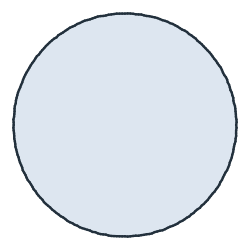
(a) 256 measured points joined
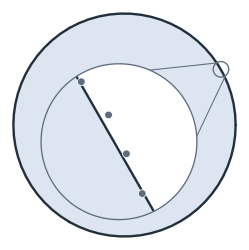
(b) Fitted: 3 arcs
[5]:
print("radii", [round(e.edge.radius, 4) for e in fitted.edges])
print("area", fitted.mass, "circle", math.pi * 100)
radii [10.0066, 10.0603, 9.9984]
area 314.21891028047474 circle 314.1592653589793
Tolerance
A fit needs a tolerance above the noise of its points. The example is a unit circle of 64 points with their coordinates rounded to three digits. Below the rounding, the fits deviate from the edges by more than allowed and are rejected, so the 64 edges remain. Just above it, only some chains fit, and well above it, the circle becomes two arcs.
[6]:
rounded = [(round(math.cos(2 * math.pi * k / 64), 3), round(math.sin(2 * math.pi * k / 64), 3)) for k in range(64)]
circle = px.Face([px.FromPolyline(rounded, closed=True)])
for tol in (1e-5, 1e-4, 1e-3):
    f = circle.Copy().FitArcs(tol=tol, max_edge_length=0.2)
    radii = [e.edge.radius for e in f.edges if hasattr(e.edge, "radius")]
    error = max(abs(r - 1) for r in radii) if radii else "none, no arcs fitted"
    print("tol", tol, ":", len(f.edges), "edges, largest radius error", error)
tol 1e-05 : 64 edges, largest radius error none, no arcs fitted
tol 0.0001 : 40 edges, largest radius error 0.01307012691401388
tol 0.001 : 2 edges, largest radius error 2.294391787671657e-09
On export
The exports take the same options, and the exported face of the rounded circle has 2 edges instead of 64:
[7]:
exported = circle.ToOCCShape(fit_arcs=dict(max_edge_length=0.2, tol=1e-3))
print(len(exported.edges), "edges")
2 edges