Cycloidal drive: the disc cut by its pins
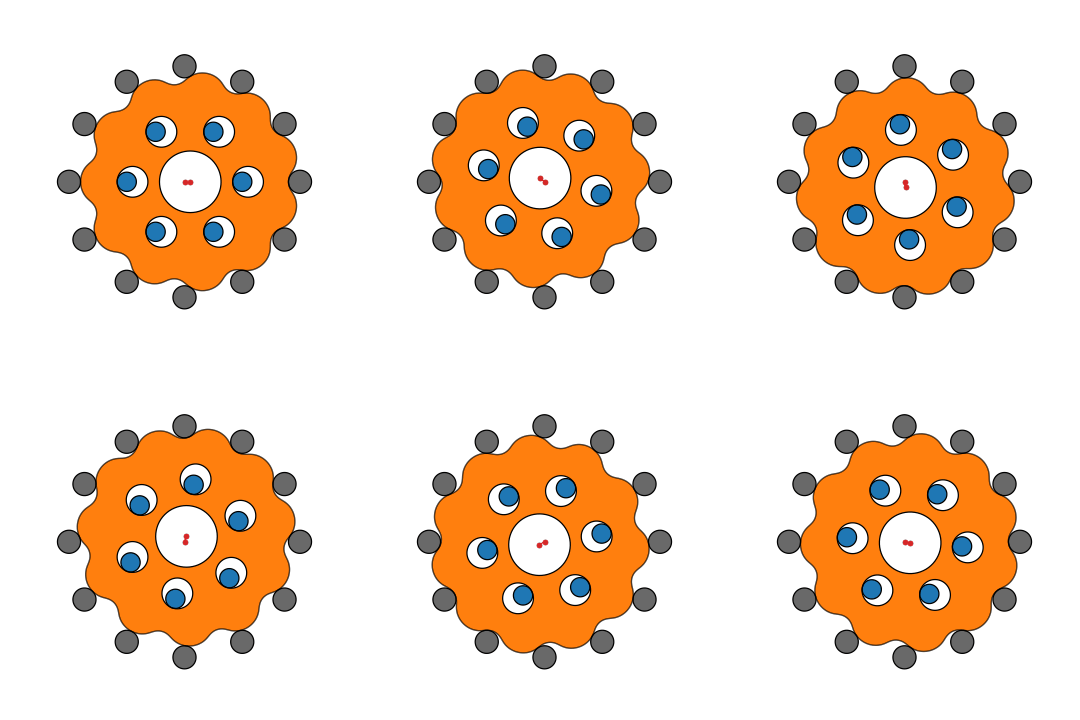
The example is a cycloidal drive, the gearbox in many robot joints. A disc with N − 1 lobes rolls inside a ring of N pins. The input crank moves the disc’s center on a small circle, and for every turn of the crank, the disc turns back by one lobe, so the output turns N − 1 times slower and in the opposite direction. The disc’s outline is not drawn; it is what is left of a blank when every pin, at every crank angle, is cut away. Lengths are in mm.
[1]:
import math
import matplotlib.pyplot as plt
from matplotlib.animation import FuncAnimation
from IPython.display import HTML
import planex as px
The dimensions
The ring has N = 12 pins of radius pin = 3 on a circle of R = 30, and the crank’s eccentricity is e = 1.5. The output has six pins of radius 2.5 on a circle of 15. The disc has N − 1 = 11 lobes, so the ratio is 11 to 1:
[3]:
N = 12
R = 30.0
pin = 3.0
e = 1.5
lobes = N - 1
ring = [(R * math.cos(2 * math.pi * k / N), R * math.sin(2 * math.pi * k / N)) for k in range(N)]
print(N, "pins,", lobes, "lobes")


def disc(x, y, r):
    return px.QuickSketch().Circle(x, y, r).Face()
12 pins, 11 lobes
The disc
Seen from the disc, the pins move. At crank angle θ, the disc’s center is at e (cos θ, sin θ), and the disc has turned by −θ / (N − 1). Cutting all pins at 360 crank angles out of a blank leaves the cycloidal outline. The disc also gets a bore of 16 for the eccentric and holes for the output pins, e wider than the pins so that they can follow the wobble (Figure 1).
[4]:
def from_disc(theta):
    turn = -math.degrees(theta) / lobes
    cx, cy = e * math.cos(theta), e * math.sin(theta)
    return [disc(x, y, pin).Translated((-cx, -cy)).Rotated((0, 0), -turn) for x, y in ring]


cuts = px.Unify([p for k in range(360) for p in from_disc(2 * math.pi * k / 360)])
holes = [disc(15 * math.cos(math.pi * k / 3), 15 * math.sin(math.pi * k / 3), 2.5 + e) for k in range(6)]
cam = px.Subtract([disc(0, 0, R), cuts, disc(0, 0, 8.0), *holes]).faces[0]
print("disc area", round(cam.mass, 3), "mm², outline", round(cam.outer.mass, 3), "mm long")
disc area 1820.236 mm², outline 187.036 mm long

Check: the outline crosses the circle halfway between its tips and its valleys twice per lobe:
[6]:
radii = [math.hypot(x, y) for x, y in cam.outer.ToShapely(0.01).coords]
middle = (max(radii) + min(radii)) / 2
crossings = cam.outer.Intersections(px.QuickSketch().Circle(middle).Wire())
print(len(crossings), "crossings,", len(crossings) // 2, "lobes")
22 crossings, 11 lobes
Running
The disc placed at a crank angle must touch the pins without overlapping them. With pins 0.01 thinner, the ones within 0.02 of the disc count as in contact. In a perfect cycloidal drive, every pin touches the disc at every moment, and half of them push. The output pins must stay free inside their holes. Checks every 10° of the crank:
[7]:
def placed(theta):
    turn = -math.degrees(theta) / lobes
    return cam.Rotated((0, 0), turn).Translated((e * math.cos(theta), e * math.sin(theta)))


def output_pins(theta):
    turn = -theta / lobes
    return [disc(15 * math.cos(turn + math.pi * k / 3), 15 * math.sin(turn + math.pi * k / 3), 2.5)
            for k in range(6)]


worst, touching = 0.0, []
for k in range(0, 360, 10):
    theta = 2 * math.pi * k / 360
    body = placed(theta)
    pins = [disc(x, y, pin - 0.01) for x, y in ring]
    worst = max([worst] + [(body * p).mass for p in pins] + [(body * p).mass for p in output_pins(theta)])
    touching.append(sum(1 for p in pins if body.Distance(p) < 0.02))
print("largest overlap", worst, "mm²")
print("pins in contact", min(touching), "to", max(touching), "of", N)
largest overlap 0.0 mm²
pins in contact 12 to 12 of 12
In motion
During two turns of the crank, the disc wobbles, and the output with its pins turns by two lobes the other way.
[8]: