The isoperimetric inequality
Of all closed curves of a given length, which one encloses the most area? The circle, and the isoperimetric inequality says by how much: for any curve of length \(L\) around an area \(A\),
with equality only for the circle. The isoperimetric quotient \(Q = 4\pi A / L^2\) is therefore 1 for a circle and less for every other shape, and it measures how round a shape is.
Here, planex2d measures the area and the length of several shapes exactly, and their quotients are checked against the closed forms.

[1]:
import math

import planex as px
from scipy.special import ellipe
Shapes of one perimeter
The quotient does not depend on a shape’s size, so each shape is drawn at a convenient one. The shapes are a circle of radius 1, a Reuleaux triangle of width 1 from three arcs about the corners of a triangle, an ellipse of semi-axes 2 and 1, a square and an equilateral triangle. Their exact quotients are
\(2(\pi - \sqrt{3})/\pi\) for the Reuleaux triangle, of area \((\pi - \sqrt{3})/2\) and length \(\pi\);
\(4\pi^2 a b / L^2\) for the ellipse, of length \(L = 4a\,E(1 - b^2/a^2)\), with \(E\) the complete elliptic integral of the second kind;
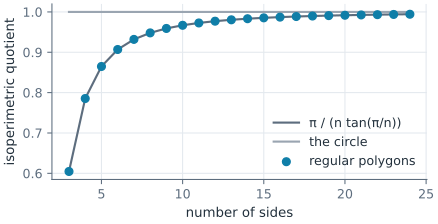
\(\pi / (n \tan(\pi/n))\) for a regular polygon of \(n\) sides, \(\pi/4\) for the square.
[3]:
corners = [(0.0, 0.0), (1.0, 0.0), (0.5, math.sqrt(3) / 2)]
reuleaux = px.QuickSketch(corners[1]).Arc(center=corners[0], sweep=60).Arc(center=corners[1], sweep=60)
reuleaux.Arc(center=corners[2], sweep=60)
shapes = {
    "circle": (px.Circle((0, 0), 1).Face(), 1),
    "Reuleaux triangle": (reuleaux.Face(), 2 * (math.pi - math.sqrt(3)) / math.pi),
    "ellipse": (px.Face([px.Ellipse((0, 0), 2, 1)]), 4 * math.pi**2 * 2 / (4 * 2 * ellipe(1 - 1 / 4)) ** 2),
    "square": (px.QuickSketch().RectangleC(1, 1).Face(), math.pi / 4),
    "triangle": (px.QuickSketch().Polygon((0, 0), 1, 3).Face(), math.pi / (3 * math.tan(math.pi / 3))),
}
for name, (face, exact) in shapes.items():
    print(name, "| Q", 4 * math.pi * face.mass / face.outer.mass**2, "| exact", exact)
circle | Q 1.0 | exact 1
Reuleaux triangle | Q 0.8973422091564158 | exact 0.8973422091564159
ellipse | Q 0.8411651810063179 | exact 0.8411651810063192
square | Q 0.7853981633974483 | exact 0.7853981633974483
triangle | Q 0.6045997880780726 | exact 0.6045997880780728
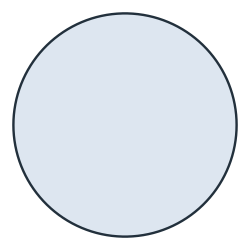
(a) Circle, Q = 1.000
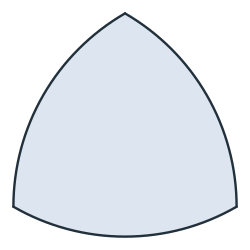
(b) Reuleaux triangle, Q = 0.897
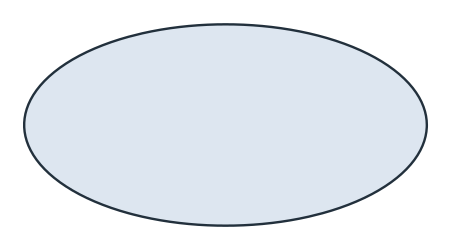
(c) Ellipse, Q = 0.841
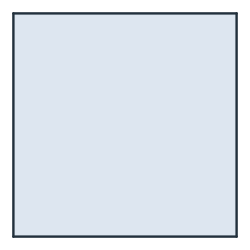
(d) Square, Q = 0.785
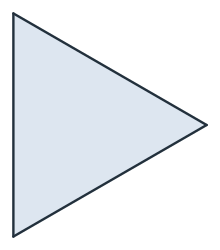
(e) Triangle, Q = 0.605
Polygons toward the circle
The more sides a regular polygon has, the closer it comes to the circle, and its quotient rises toward 1 (Figure 2):
Dido’s problem
Dido’s problem, named after the legend of Queen Dido’s ox hide, asks for the most land along a straight coast. The coast closes the curve for free, and a rope of length \(\ell\) then encloses the most area as a half circle, the mirror image of the isoperimetric circle, with the area \(\ell^2 / (2\pi)\). A rectangle with the same rope, best as twice as long as it is deep, encloses only \(\ell^2/8\):
[6]:
rope = 100.0
r = rope / math.pi
half = px.QuickSketch((-r, 0)).Line(2 * r).Turn(90).Arc(r, 180).Face()
box = px.QuickSketch((-rope / 4, 0)).Rectangle(rope / 2, rope / 4).Face()
print("half circle", half.mass, "| ℓ²/2π", rope**2 / (2 * math.pi), "| rope", half.outer.mass - 2 * r)
print("rectangle", box.mass, "| ℓ²/8", rope**2 / 8, "| rope", box.outer.mass - rope / 2)
half circle 1591.5494309189532 | ℓ²/2π 1591.5494309189535 | rope 100.0
rectangle 1250.0 | ℓ²/8 1250.0 | rope 100.0