Clevis
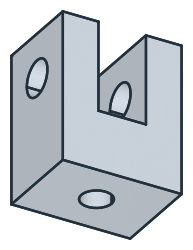
A clevis joins a rod to a link. The rod screws into its base, and a pin passes through both prongs of its fork and the link between them. As a solid, it is a U profile padded, a pin hole cut through both prongs at once, and a blind hole in its base. Model the clevis from the drawing in planex2d or in any CAD system, then check its volume, mass and center of mass against the values at the end of the page. A solution in planex2d follows.

[1]:
import math
import netgen.occ as occ
import planex as px
The profile
The profile is the front view, sketched in the front plane, the plane with its normal toward the viewer, \(-y\). It has \(x\) to the right and \(z\) up, with the origin in the middle of the bottom. The outline runs from the bottom left corner along the bottom, up the right side, over the right prong, down into the fork, across its bottom and up the left prong’s inside. With auto_constraint=True, the flags px.Horizontal and px.Vertical become constraints.
The clevis is 40 wide and 50 high, its fork 16 wide and 30 deep. The left prong’s inside and top mirror the right ones about the vertical axis, which sets their directions too. With these, nothing in the sketch is left free (Figure 1):
[3]:
front = px.XZ
u = px.Sketch(front, auto_constraint=True)
u.Move((-20, 0)).Line(40, px.Horizontal, id="bottom")
u.Turn(90).Line(50, px.Vertical, id="right_side")  # Turn(90) turns the pen left, Turn(-90) right
u.Turn(90).Line(12, px.Horizontal, id="right_top")
u.Turn(90).Line(30, px.Vertical, id="right_cheek")
u.Turn(-90).Line(16, px.Horizontal, id="fork_bottom")
u.Turn(-90).Line(30, id="left_cheek")
u.Turn(90).Line(12, id="left_top")
u.Close(px.Vertical, id="left_side")
u.Constrain("bottom.mid", "origin", px.Coincident)
u.Constrain("bottom", px.Distance, 40, id="width")
u.Constrain("right_side", px.Distance, 50, id="height")
u.Constrain("right_cheek", "left_cheek", px.Distance, 16, id="gap")
u.Constrain("right_cheek", px.Distance, 30, id="fork_depth")
u.Constrain("left_cheek", "right_cheek", "V", px.SymmetricCarriers)
u.Constrain("left_top", "right_top", "V", px.SymmetricCarriers)
print("status", u.status, "| degrees of freedom", u.dof)
status full | degrees of freedom 0
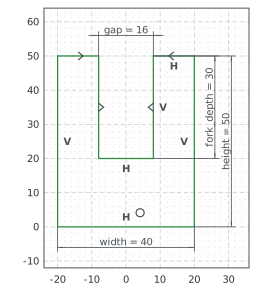
The clevis
px.Pad extrudes the profile 15 to both sides of the front plane, 30 in all (Figure 2):
[5]:
clevis = px.Pad(u, 15, length2=15)
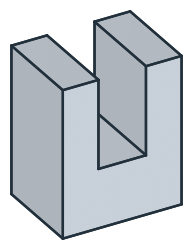
The pin hole
The pin hole, 12 across, is sketched on the right prong’s outside, the face highest in \(x\). The sketch’s axes there are \(y\) and \(z\), the global origin projected onto the face giving its origin, so its vertical axis runs through the middle of the clevis’s depth. The hole’s center lies on that axis, 15 below the face’s projected top edge. until=px.last cuts the hole through the right prong, across the fork and through the left prong, to the last face it crosses (Figure 3):
[7]:
side = clevis.faces.Max(occ.X)
pin = px.Sketch(side)
pin.Project(side.edges.Max(occ.Z), id="top_edge")
pin.Circle(12 / 2, center=(0, 30), id="pin_hole")
pin.Constrain("pin_hole", px.Diameter, 12, id="pin_d")
pin.Constrain("pin_hole.center", "top_edge.Edge.0", px.Distance, 15, id="pin_from_top")
pin.Constrain("pin_hole.center", "V", px.Coincident)
print("status", pin.status, "| degrees of freedom", pin.dof)
clevis = px.Pocket(clevis, pin, until=px.last)  # through both prongs, to the last flat face it crosses
status full | degrees of freedom 0
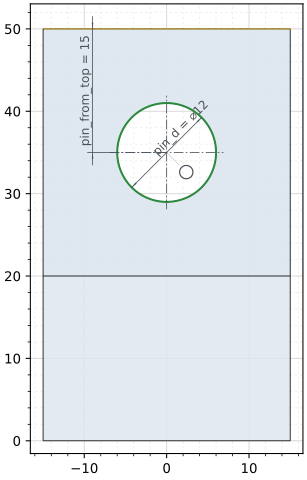
(a) The pin hole on the right prong, the clevis behind it
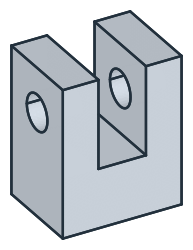
(b) The pin hole through both prongs
The rod hole
The rod screws into a blind hole in the base, the tapping hole of 10.2 for an M12 thread, 18 deep, sketched on the bottom, the face lowest in \(z\) (Figure 4):
[9]:
rod = px.Sketch(clevis.faces.Min(occ.Z))
rod.Circle(10.2 / 2, id="rod_hole")
rod.Constrain("rod_hole.center", "origin", px.Coincident)
rod.Constrain("rod_hole", px.Diameter, 10.2, id="rod_d")
clevis = px.Pocket(clevis, rod, 18)  # 18 deep, against the face's normal: up into the base
The checks
These are the volume, the mass in steel S235 (7.85 g/cm³) and the center of mass, with the origin in the middle of the bottom, to compare with your own model. The volume is the profile’s area, \(40 \cdot 50\) less the fork’s \(16 \cdot 30\), times 30, less the pin hole through the two prongs, 12 thick each, and the rod hole. The clevis is symmetric about two planes, so its center of mass lies on the vertical axis:
[11]:
exact = (40 * 50 - 16 * 30) * 30 - math.pi * 6**2 * 2 * 12 - math.pi * 5.1**2 * 18
c = clevis.center
print("volume", round(clevis.mass, 1), "mm³, exact", round(exact, 1))
print("mass", round(clevis.mass * 7.85e-6, 3), "kg")
print("center of mass", round(c.z, 2), "above the bottom, off the axis by", round(math.hypot(c.x, c.y), 6))
volume 41414.8 mm³, exact 41414.8
mass 0.325 kg
center of mass 21.44 above the bottom, off the axis by 0.0
The clevis as STEP, for another CAD system:
[12]:
clevis.WriteStep("clevis.step")
The clevis as STEP: clevis.step