Faces and wires
Faces combine with faces, and wires with wires. face + wire raises a TypeError. A union of wires cuts them at every crossing and keeps overlapping stretches once, while gluing cuts them the same way but keeps every wire as its own part. See Splitting and trimming for cutting a face along a wire.
[1]:
import math
import planex as px
A truss from its member center lines
The example is a Pratt truss with a span of 12 in four panels of 3 and a height of 2, its members drawn as single lines: the two chords, five verticals and four diagonals that slope down toward the middle. The union cuts the chords at the panel points, so every edge of the result runs from one joint to the next (Figure 1, with the joints marked).
[3]:
members = [px.Line((0, 0), (12, 0)), px.Line((0, 2), (12, 2))]
members += [px.Line((3 * k, 0), (3 * k, 2)) for k in range(5)]
members += [px.Line((0, 2), (3, 0)), px.Line((3, 2), (6, 0)), px.Line((6, 0), (9, 2)), px.Line((9, 0), (12, 2))]
truss = px.Unify(members)
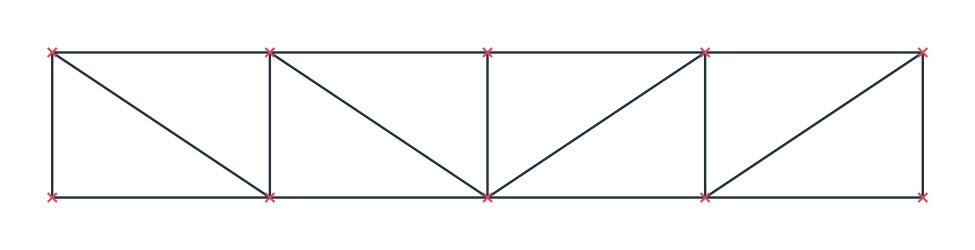
The members add up to two chords of 12, five verticals of 2 and four diagonals of √13. The mass of a shape is the area of its faces, so the length is summed over its wires:
[5]:
length = sum(wire.mass for wire in truss.wires)
print(len(truss.edges), "edges, length", length, "exact", 2 * 12 + 5 * 2 + 4 * math.sqrt(13))
17 edges, length 48.42220510185596 exact 48.42220510185596
Glued, the members stay separate
px.Glue cuts the wires against each other as the union does, but every member remains its own wire:
[6]:
glued = px.Glue(members)
print(len(glued.wires), "wires from", len(members), "members")
11 wires from 11 members
Overlapping stretches are kept once
The example is two lines on the x axis, from 0 to 2 and from 1 to 3. They unite into a single edge of length 3:
[7]:
merged = px.Line((0, 0), (2, 0)) + px.Line((1, 0), (3, 0))
print(len(merged.edges), "edge, length", merged.wires[0].mass)
1 edge, length 3.0