Boxes, crossings and open ends
Queries find things in an object without changing it: its bounding box, its edges by name, the points where a line crosses it, and its outline and holes. All examples on this page use the link from Tangents, two bosses of radius r1 = 1.5 and r2 = 1 with their centers d = 6 apart, joined by tangent lines, with a hole in each boss.
[1]:
import math
import planex as px

link = px.QuickSketch()
link.Circle(0, 0, 1.5, id="boss1", construction=True)
link.Circle(6, 0, 1.0, id="boss2", construction=True)
link.Line(tangent=("boss1", "boss2"), id="upper", name="upper")
link.Line(tangent=("boss1", "boss2"), reverse=True, id="lower", name="lower")
link.Arc("lower", "upper", congruent="boss2", id="end2")
link.Arc("upper", "lower", congruent="boss1", id="end1")
link.Circle(0, 0, 0.6, id="hole1").Circle(6, 0, 0.4, id="hole2")
face = link.Face()
r1, r2, d = 1.5, 1.0, 6.0
Box, edges by name, crossings
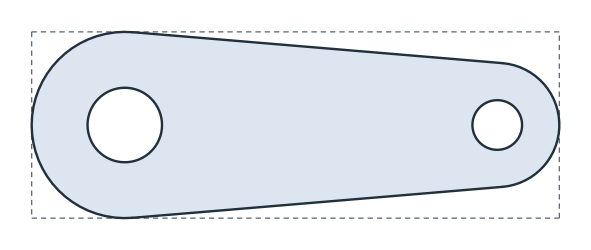
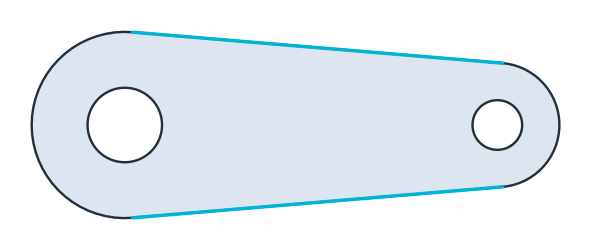
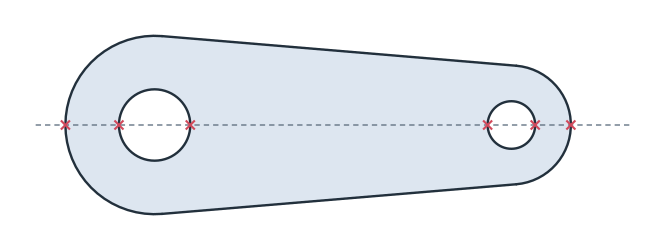
The example makes three queries on the link (Figure 1):
The bounding box: the end arc of the large boss reaches over its top and bottom, and that of the small boss over its far side.
The two tangent lines, found by their names with
edges(name="upper|lower"). Each is √(d² − (r1 − r2)²) long.The points where the center line crosses the outline and the holes. The differences of the first two and of the last two crossings are the wall thicknesses around the holes.
[3]:
box = face.bounding_box
tangents = face.edges(name="upper|lower")
center_line = px.Line((-2, 0), (8, 0))
xs = sorted(p.h for p in face.Intersections(center_line))
(a) The bounding box
(b) The tangent lines
(c) The center line's crossings
[5]:
print("box", box, "exact", ((-r1, -r1), (d + r2, r1)))
print([(e.name, e.mass) for e in tangents], "exact", math.sqrt(d**2 - (r1 - r2) ** 2))
print("crossings", xs)
print("walls", xs[1] - xs[0], xs[5] - xs[4])
box ((-1.5, -1.5), (7.0, 1.5)) exact ((-1.5, -1.5), (7.0, 1.5))
[('upper', 5.979130371550699), ('lower', 5.979130371550699)] exact 5.979130371550699
crossings [-1.5, -0.6, 0.6, 5.6, 6.4, 7.0]
walls 0.9 0.5999999999999996
Outline and holes
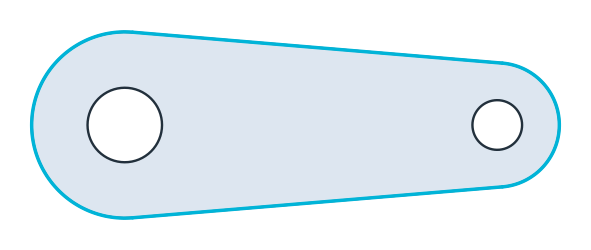
outer and inner are the loops of a face. The outline of the link consists of the two tangents, the arc of the large boss over π + 2α and the arc of the small boss over π − 2α. Its holes are two full circles (Figure 2).
[6]:
alpha = math.asin((r1 - r2) / d)
tangents = 2 * math.sqrt(d**2 - (r1 - r2) ** 2)
outline = tangents + r1 * (math.pi + 2 * alpha) + r2 * (math.pi - 2 * alpha)
print("outline", face.outer.mass, "exact", outline)
holes = sorted(h.mass for h in face.inner)
print("holes", holes, "exact", [2 * math.pi * 0.4, 2 * math.pi * 0.6])
outline 19.895672463686495 exact 19.895672463686495
holes [2.5132741228718367, 3.7699111843077517] exact [2.5132741228718345, 3.7699111843077517]
(a) The outline
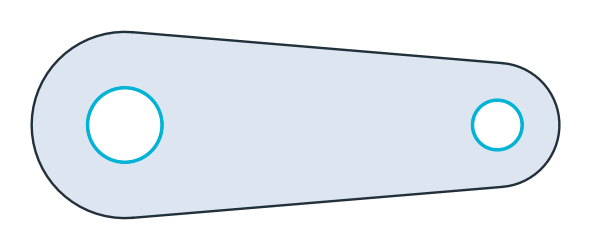
(b) The holes
Open ends
IsClosed() tells whether the wires of a sketch are closed, before they are made into a face:
[8]:
print([w.IsClosed() for w in link.Wires()])
[True, True, True]