Formula Student rear wing with DRS
The example is the three-element rear wing of a Formula Student car with DRS: on the straights, the top flap swings open about a hinge at its trailing edge to cut drag. In 3D, the wing is a part with its endplates. In 2D, it is a section, meshed in a wind tunnel. Lengths are in chords of the main plane.

[1]:
import math
import netgen.occ as occ
import ngsolve as ngs
from ngsolve_webgpu.jupyter import Draw
import planex as px
The elements
The elements are NACA 6412 profiles turned upside down, so that they push the car down:
Element |
Chord |
Incidence |
|---|---|---|
|
1 |
3° |
|
0.45 |
16° |
|
0.35 |
30° |
Each flap starts 0.06 ahead of the trailing edge of the element before it and above it, by 0.042 and 0.03, so that the elements overlap with a slot of about 2 % of the main chord between them, as on real wings. Through the slot, fresh air reaches the flap’s suction side. wing places the elements one after the other and turns the DRS flap about its hinge at its trailing edge (the dot in Figure 1).
[3]:
elements = [("main", 1.00, 3.0), ("flap1", 0.45, 16.0), ("flap2", 0.35, 30.0)]


def element(name, chord, incidence, leading_edge):
    face = px.FromNACA("6412", chord=chord).Mirrored((0, 0), (1, 0)).Rotated((0, 0), incidence)
    face = face.Translated(leading_edge)
    face.edges.name = name
    a = math.radians(incidence)
    return face, (leading_edge[0] + chord * math.cos(a), leading_edge[1] + chord * math.sin(a))


def wing(opening=0.0):
    faces, leading_edge = [], (0.0, 0.0)
    for (name, chord, incidence), gap in zip(elements, (0.042, 0.03, 0.0)):
        face, trailing_edge = element(name, chord, incidence, leading_edge)
        faces.append(face)
        leading_edge = (trailing_edge[0] - 0.06, trailing_edge[1] + gap)
    faces[-1].Rotate(trailing_edge, -opening)
    return faces, trailing_edge
Opening the DRS turns the flap from 30° to 17°, by turn = 13°. It lifts the flap’s nose away from the flap below and widens the slot between them (Figure 1):
[4]:
turn = 30 - 17
closed_faces, hinge = wing()
open_faces, _ = wing(turn)
print("slots closed", [round(a.Distance(b), 4) for a, b in zip(closed_faces, closed_faces[1:])])
print("slots open", [round(a.Distance(b), 4) for a, b in zip(open_faces, open_faces[1:])])
slots closed [0.0211, 0.0272]
slots open [0.0211, 0.0895]
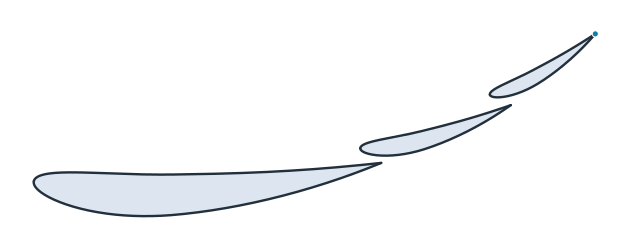
(a) DRS closed
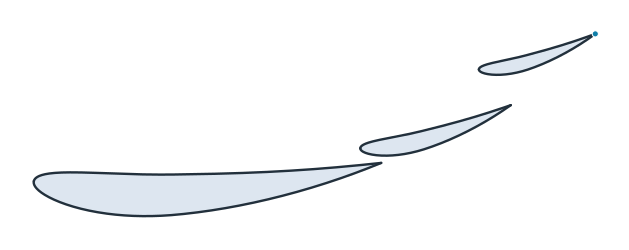
(b) DRS open
In 3D
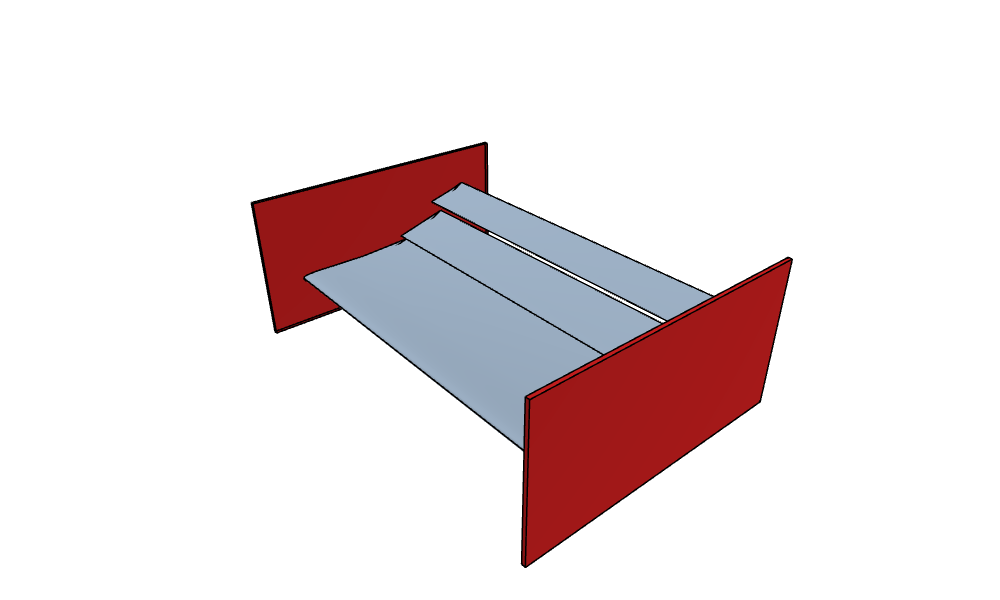
The united section is extruded over a span of 3. The endplate is sketched on the end face of the extrusion, as a rectangle 0.3 larger on every side than the closed wing, and extruded outwards by 0.03. A copy moved by the span closes the other side.
[6]:
(x0, y0), (x1, y1) = px.Unify(closed_faces).bounding_box


def wing3d(opening):
    body = px.Unify(wing(opening)[0]).ToOCCShape().Extrude(3)
    end = px.QuickSketch(body.faces.Max(occ.Z))
    end.Move((x0 - 0.3, y0 - 0.3)).Rectangle(x1 - x0 + 0.6, y1 - y0 + 0.6)
    plate = end.Face().ToOCCFace().Extrude(0.03)
    other = plate.Move((0, 0, -3.03))
    body.faces.col = (0.624, 0.702, 0.784)
    for p in (plate, other):
        p.faces.col = (0.80, 0.12, 0.12)
    return occ.Compound([body, plate, other])

Draw(wing3d(0), euler_angles=[30, 40, 0])
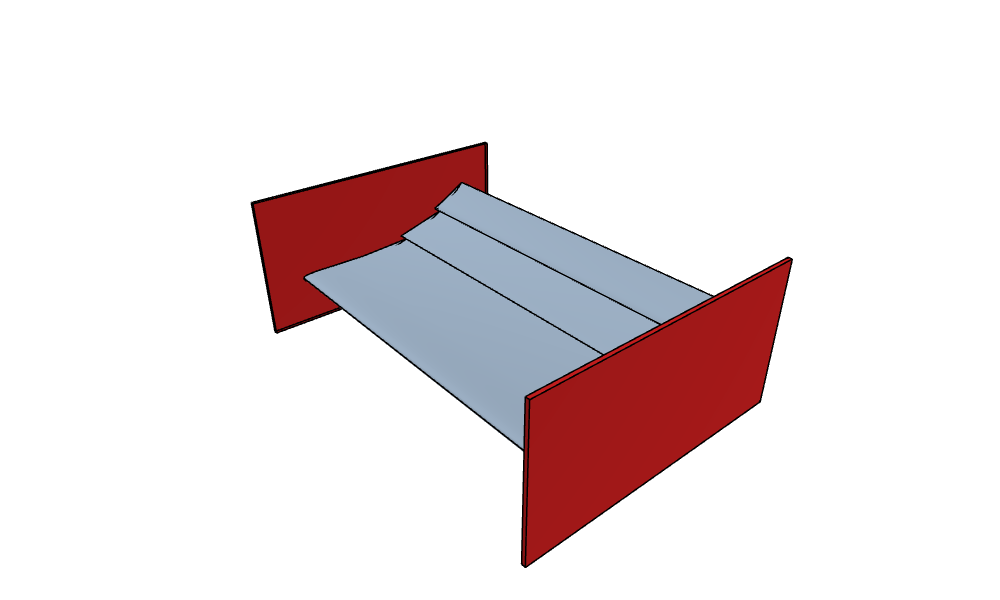
The same wing with the DRS open:
[7]:
Draw(wing3d(turn), euler_angles=[30, 40, 0])
In the wind tunnel
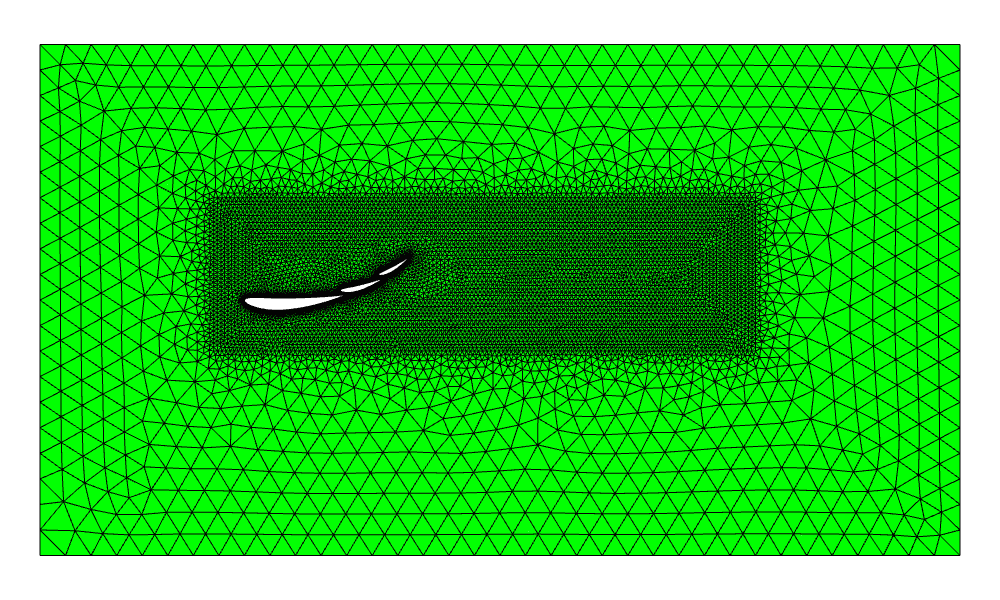
The 2D section sits in a channel of 9 × 5 without endplates, with uniform inflow from the left, free outflow on the right, and slip walls on the top and bottom. The mesh sizes:
the wing’s edges get elements of 0.004 and, through hp refinement, layers of thin elements towards them for the boundary layers;
a region of 5.3 × 1.5 around the wing and its wake gets elements of 0.04, fine enough for the vortices;
the rest of the channel gets elements of 0.25.
The elements keep their edge names through the subtraction, so the wing is a named boundary of the fluid.
[8]:
def tunnel():
    channel = px.QuickSketch((-2, -2.5))
    channel.Line((7, -2.5), name="bottom").Line((7, 2.5), name="outlet").Line((-2, 2.5), name="top")
    channel.Close(name="inlet")
    wake = px.QuickSketch((-0.3, -0.5)).Rectangle(5.3, 1.5).Face()
    wake.maxh = 0.04
    faces, _ = wing()
    for f in faces:
        f.edges.maxh = 0.004
        f.edges.hpref = 1
    return px.Subtract([px.Glue([channel.Face(), wake]), *faces])

mesh = ngs.Mesh(px.OCCGeometry(tunnel()).GenerateMesh(maxh=0.25))
mesh.RefineHP(levels=2)
mesh.Curve(3)
print(mesh.ne, "elements")
Draw(mesh)
24032 elements