Many faces at once
px.Unify, px.Intersect and px.Subtract take a list of faces and combine them as a balanced tree, on all cores by default. px.Subtract([first, *others]) cuts all the other faces out of the first one.
[1]:
import math
import random
import time
import planex as px
A perforated sheet
The example is a sheet of 1000 × 500 with holes of diameter 8 on a grid of 20, so 1250 holes are subtracted in one call (Figure 1). The time is measured on the machine that built this page.
[3]:
sheet = px.QuickSketch().Rectangle(1000, 500).Face()
holes = [px.Circle((10 + 20 * i, 10 + 20 * j), 4).Face() for i in range(50) for j in range(25)]

start = time.perf_counter()
perforated = px.Subtract([sheet, *holes])
print(len(holes), "holes in", round(time.perf_counter() - start, 3), "s")
print("area", perforated.mass, "exact", 1000 * 500 - len(holes) * 16 * math.pi)
1250 holes in 0.009 s
area 437168.1469282339 exact 437168.1469282041

A Reuleaux triangle
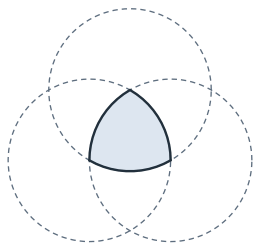
A Reuleaux triangle is the intersection of three discs of radius s centered on the corners of an equilateral triangle of side s, and its area is (π − √3) s² / 2. The example has s = 10 (Figure 2, with the circles dashed).
[5]:
corners = [(0, 0), (10, 0), (5, 5 * math.sqrt(3))]
reuleaux = px.Intersect([px.Circle(c, 10).Face() for c in corners])
print("area", reuleaux.mass, "exact", (math.pi - math.sqrt(3)) * 100 / 2)
area 70.47709230104581 exact 70.4770923010458
A stress test
The example unites 2000 random discs, on all cores and then on one core with multithreaded=False (Figure 3). The times are again those of the build machine.
[7]:
random.seed(1)
discs = [px.Circle((random.uniform(0, 50), random.uniform(0, 50)), random.uniform(0.3, 1.2)).Face()
         for _ in range(2000)]

start = time.perf_counter()
union = px.Unify(discs)
print("all cores", round(time.perf_counter() - start, 3), "s")
start = time.perf_counter()
px.Unify(discs, multithreaded=False)
print("one core", round(time.perf_counter() - start, 3), "s")
all cores 0.013 s
one core 0.049 s
